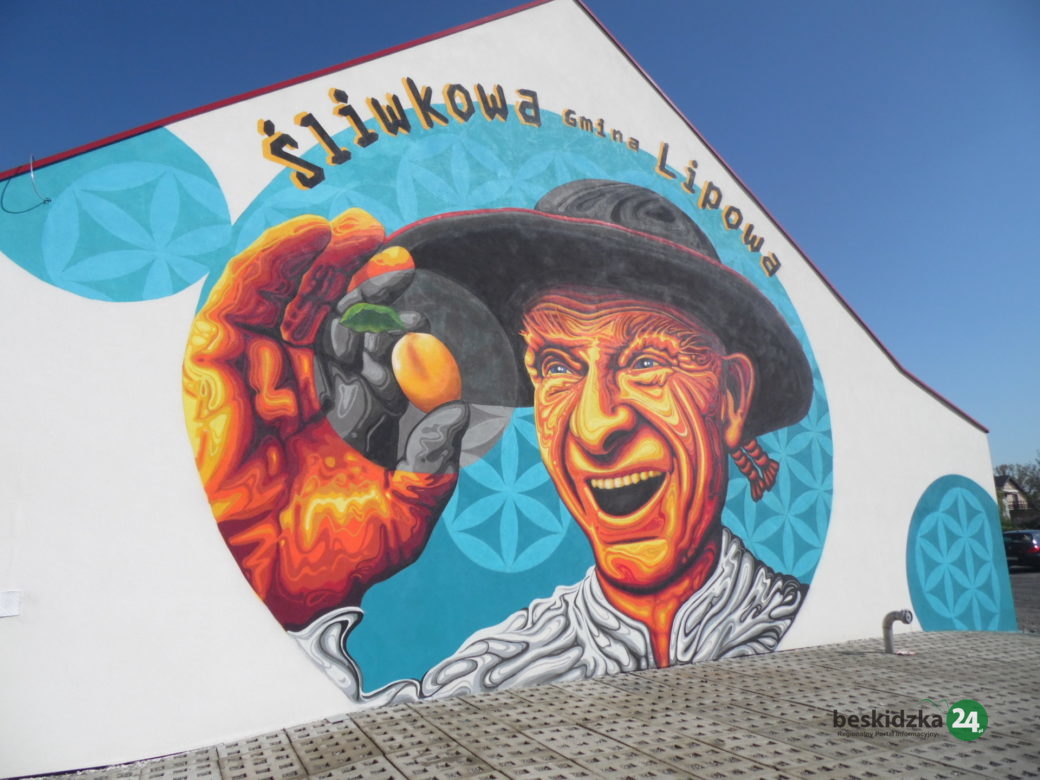
You can expect many things in the mountains – a mother bear with cubs; darkness falling faster than it should; or a thunderstorm on a perfectly sunny day. But stumbling upon a mural trail (!) was definitely not on my bingo card. And all of this… in the Beskid Mountains!
Table of contents:
- Beskid Mural Trail: who’s behind it?
- Beskid Mural Trail: Map
- Beskid Mural Trail: Route
- Beskid Mural Trail: how to prepare?
Beskid Mural Trail: who’s behind it?
The Beskid Mural Trail is a project created by Maciej Szymanowicz (Etnograff).
The murals were created to promote the local cultural heritage of the Beskidy Zachodnie, including traditional highlander culture. They are not only meant to catch your eye (and the most of they do!), but also to encourage you to learn more about the traditions of each place. And here’s an important detail – mural’s location matters. The setting of each mural is essential for understanding its meaning.
It’s also worth mentioning that not every mural in the Beskids belongs to the official Beskid Mural Trail overseen by Etnograff. The official ones can be recognized by a characteristic black rosette on a white background.
To be honest, I only managed to see four out of fifteen murals in person. But since I was already planning this trip for myself, I thought why not share it with you as well?
Beskid Mural Trail: Map
I did some digging online and, based on everything I managed to find, I created my own map. I’m planning to use it myself in close or further future, so expect updates along the way.

The Beskid Mural Trail stretches from the village of Zawoja in the east all the way to Jablunkov in the Czech Republic in the west. The southernmost point seems to be Jaworzynka, while in the north you’ll find Bielsko-Biała. That last city deserves a separate post, though — there’s way more street art there than just this trail, and I already have plans to explore it properly.
I counted 15 murals as part of the official trail. On my map, you’ll also find two additional murals in Koniaków, including one by Nespoon, plus an extra one in Jeleśnia.
Beskid Mural Trail: Route
I suggest starting this adventure in the village of Lipowa, in the Żywiec region.
This is where the very first mural of the Beskid Mural Trail was created. The one that started it all. The artwork references a local treasure: plums.

Just nearby, in the village of Twardorzeczka, you’ll find the mural “Lipka”, inspired by a paper-cut artwork designed by Katarzyna Dyga-Szymonowicz. It may look like a simple folk paper-cut, but it’s full of symbolism. You’ll spot an owl (a symbol of wisdom), tree roots (identity), and of course the linden tree – a symbol deeply rooted in Polish culture.

In the same area, in the village of Sienna, another mural awaits. This time inspired by a makatka, a traditional decorative textile that used to hang in local kitchens. The mural shows the harvest season, and interestingly, the village name Sienna itself comes from hay-related work. This mural was created by Etnograff together with Piotr Graff.
Next stop – the village of Wieprz (Radziechowy-Wieprz), where you’ll find another mural by Etnograff, dedicated to sculptor Anna Ficoń.
Next, it’s time to visit Jeleśnia – probably the most mural-packed village along the trail.
The mural “Beskidzka Natura” is one of the newest additions to the Beskid Mural Trail. It references the local fauna and flora of the surrounding forests. And honestly — this is exactly the kind of thing that makes hiking in the Beskids even more exciting. There’s always something to discover. The author of this piece is, of course, Etnograff.
Another mural in Jeleśnia features a folk-style paper-cut composition with a poem by Magdalena Zawada, along with fragments of traditional folk songs from the area. This one isn’t officially part of the Beskid Mural Trail, as it was created as part of a scholarship project by Monika Wróbel, it’s still worth checking out.
Yet another mural was created in honour of the “Masters of Tissue Paper Flowers Tradition”, thanks to the Fundacja 9sił. Tissue paper flower-making is a traditional craft based on creating decorative flowers from colourful crepe paper. Anyone who ever had art or craft classes at school knows — this kind of handmade work requires patience, precision and quite a bit of imagination.
You’ll also find the mural “Dudziarz”, created by Etnograff. Simple in form, but rich in meaning. The bagpiper portrayed in the mural represents Józef Greń from Sopotnia Mała, and the initiative behind the mural came from Fundacja 9sił.

And then… there’s the red horse.
This was actually the mural that made me realize that, besides mountain trails, there are also mural trails worth chasing in the Beskids. ^^ The intense colours, the unexpected location and the originality of the design made it impossible to look away.
This red horse represents a traditional wooden toy created by Stanisław Lach from Pewel Wielka, who received the Oskar Kolberg Award in 1994 for his contribution to folk culture.

Time to leave Jeleśnia but not too far.
In the village of Koszarawa, another mural by Etnograff presents a different traditional toy – klepoki.
Koszarawa was the first place in the region to develop toy-making, which later spread across the Żywiec-Sucha region and became the first toy-making district in Poland. At first, toy-making was just an extra source of income, but over time it became a full craft profession. This mural is dedicated to the famous folk toy-maker Władysław Sternal, and it also features a poem titled “Kloskace” by Władysław Kimla.
The easternmost mural on the trail can be found in Zawoja, at the Babia Góra Cultural Centre. Here, Etnograff created a portrait of painter Dorota Lampart, sometimes called the Nikifor of Babia Góra.
Let’s move closer to the Czech border. If you’re in this area, skipping Koniaków would be a shame. This village is famous for its traditional lace-making heritage.
You’ll find two murals here that are not officially part of the trail, but are still absolutely worth seeing. One of them was created by the brilliant artist Nespoon, whose lace-inspired works can be found all over the world.
Right next to Koniaków, in the village of Jaworzynka, there’s a mural featuring cross-stitch embroidery and a traditional embroiderer. The design is based on a specific pattern, traditionally placed on the cuffs of linen shirts worn by highlanders from Istebna, Koniaków, and Jaworzynka. This mural was created by Etnograff together with Dariusz Paczkowski.
Jaworzynka is the place where the borders of Poland, Czechia, and Slovakia meet. So technically, you can stand in three countries at once.
The Beskid Mural Trail doesn’t stop at the Polish border. One of the murals is located across the border in the Czech Republic, in the village of Jablunkov.
We’re down to the last three murals on the trail, and now we’re heading into slightly more touristy areas starting with Szczyrk.
At the Skalite Amphitheatre, you’ll find the mural “Tryptyk Karpacki”, created by Etnograff in collaboration with Marcin Malicki (Malik). The artwork was inspired by Polish-Slovak highlander culture and traditions — a perfect match for this mountainous setting.
In the village of Wilkowice, another mural features a highlander surrounded by sheep. While creating this piece, Etnograff was inspired by an old photograph taken in this very area.

And finally, we’ve reached the last mural on the Beskid Mural Trail, located in Bielsko-Biała. The mural was designed by Etnograff and painted together with Turboss (Turbograff) in 2024. You’ll find it at 13 Podchorążych Street. One important thing — Bielsko-Biała has way more murals than just this one. It’s a city that deserves a proper long walk dedicated entirely to street art. I still have that on my own to-do list, so you won’t find a full guide to Bielsko-Biała on the blog just yet.
But don’t worry — we’ll get there!
Beskid Mural Trail: how to prepare?
The murals along the trail are quite spread out, so if you’re planning to see them all in one day, having a car will definitely help. Of course, you can try combining local buses, but knowing how public transport works in Poland (especially outside cities) it can be tricky.
A great idea, I suppose, is to combine mural hunting with a multi-day mountain hike. Preparing for that kind of trip might take a bit more time, but I honestly think it’s worth the effort.
So… shall we meet on the trail? : )
Karolajn
While working on this post, I relied on information from:
- Fundacja 9sił (Jeleśnia)
- Etnografficznie – Szlak Beskidzkich Murali
- WGMedia – Szlak Beskidzkich Murali
- Gmina Lipowa
- Opencaching