
Katowice is one of the most fascinating cities in Poland. A lot of things are interesting here – an extraordinary history, unique architecture, specific and mostly nice residents, giant parks (by Polish standards), and rich cultural life. Especially when we talk about street art culture. Murals, graffiti, stickers, stencils. Name it. So, are you ready to explore?
Table of contents
- Where to find street art in Katowice?
- Katowice Street Art Festival
- Street Art in Katowice: City Center
- Street Art in Katowice: Osiedle Paderewskiego
- Street Art in Katowice: Załęże
- Street Art in Katowice: Koszutka
- Street Art in Katowice: Zawodzie
- Street Art in Katowice: Szopienice
- Katowice – is it worth to visit?
Where to find street art in Katowice?
I am a regular visitor here, in Katowice, so it’s about time to share with you some insights about this city. It’s easy to get here by train from almost every part of Poland. There is also an airport, Pyrzowice quite close. You shouldn’t have any problem to get here.
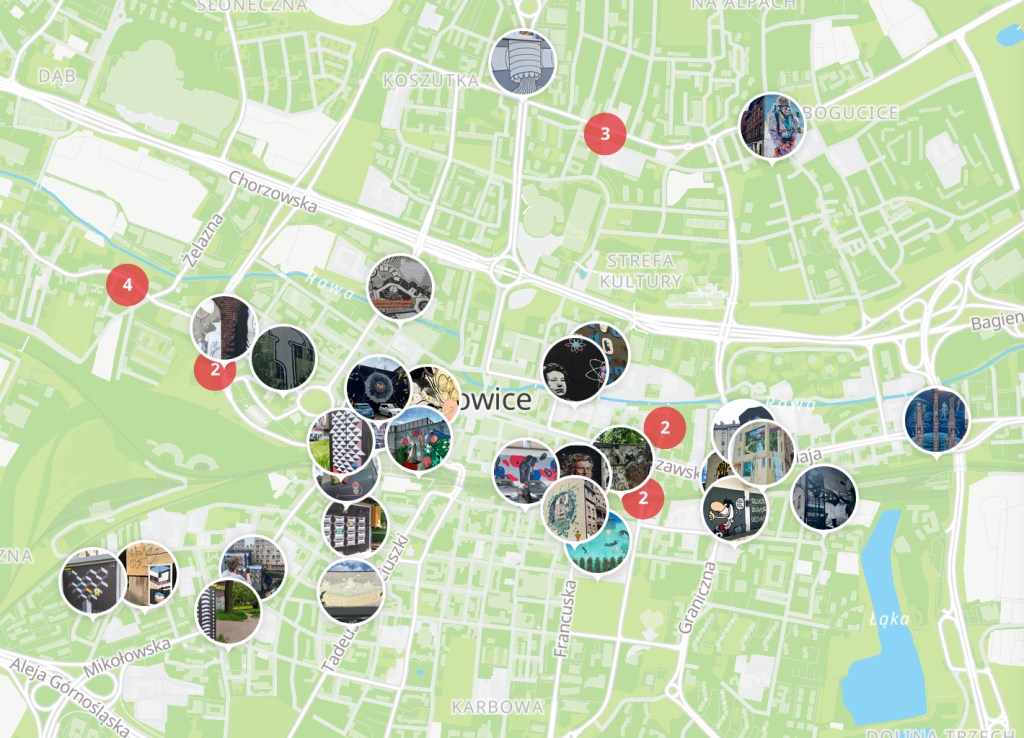
Below you’ll find an overview of the works I’ve seen in Katowice with short descriptions and sometimes my thoughts. Besides it, [HERE] you will find a map of murals, which I am updating after each visit to Katowice.
Street Art in Katowice: the map
You can learn a lot about Katowice from the murals that are created here. Especially those that were created during the Katowice Street Art Festival. Not necessarily by looking at murals, because often their message is metaphorical. Try to find out why the specific mural was created because some of them are supposed to be something more than just a nice wall. Look beyond the mural – pay attention to the neighbourhood. A good observation could help you to understand the reasons. And of course, some explanations I reveal in this article.
Katowice Street Art Festival
Before we move on to the murals, let me tell you why Katowice became famous in the street art community. The reason for this was the Katowice Street Art Festival, which took place between 2010 and 2018.
I am very impressed with how the festival has grown and had an influence on the city. The organisers were conscious of the role of independence in street art and the importance of community trust. They remembered these two things in setting festival goals.
The first two festival editions were as good as gold. The organiser just wanted to say ‘Hello, it’s us!’ and made the initiative known. A substantial part of the festival was workshops with residents to let them know about the festival and start building relationships. Besides that, the artists were created on the streets but much of the work was just urban decorations.
It was a quite thoughtful step because when the time came from the third edition of the festival, the organisers wanted to comment on the reality, not make pretty murals. So, invited artists have shared their thoughts about the city, residents, and… street art. The artists had freedom so their works are quite amazing – intriguing and meaningful. The festival showed us that unreflective art on walls is not what the city needs.
So, let’s meet the murals in Katowice. Be ready that not every painting will be easy to understand. But that’s what Katowice is – not easy, but fascinating.
Street Art in Katowice: City Center
It’s quite easy to get to Katowice by train so I recommend starting your mural journey from the train station surroundings. Within a 15-minute walk, you will find a lot of artwork here.
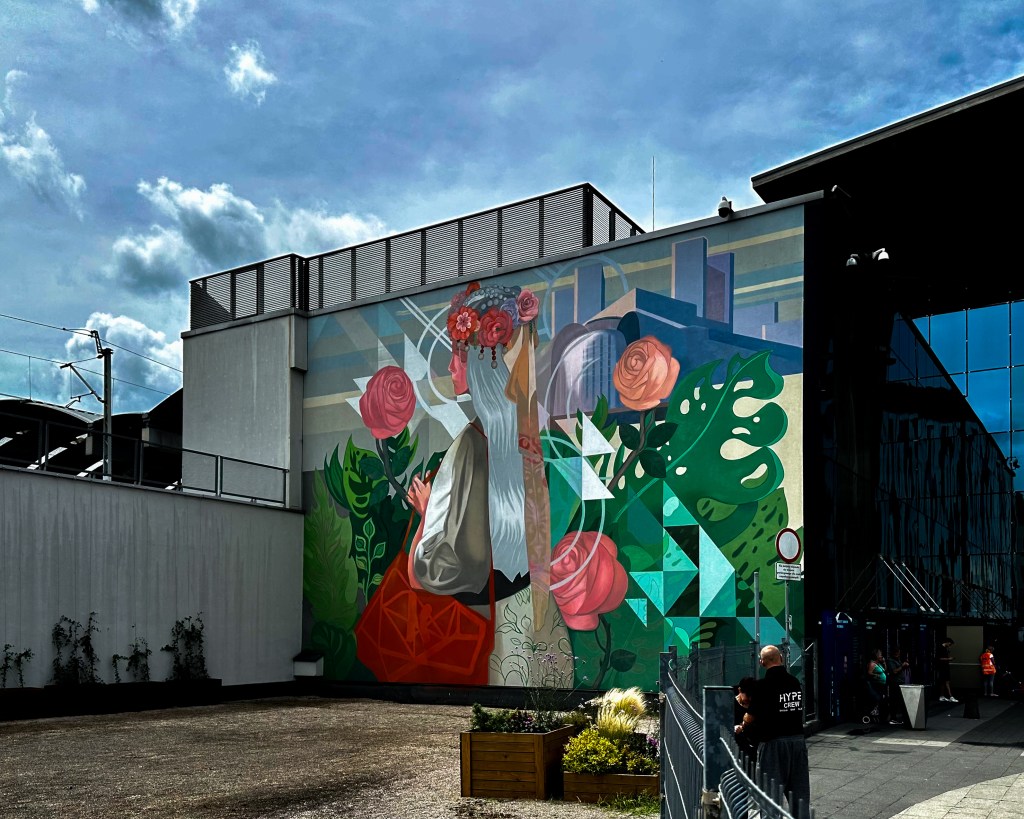
Sebastian Bożek, ul. 3 Maja 30 (on the train station’s building, from Dworcowa Street)
To see the first mural, turn right as soon as you leave the train station from 3 Maja Street. There, on the station building you will find the work of Sebastian Bożek.
There are several interesting facts about this mural. Firstly, the artwork was created in 2021 as a final of the “Clothes Full of Power” campaign. What was it about? Well, Galeria Katowicka (the name of the mall next to the station) encouraged people to recycle their unwanted clothes. In one year, they collected 9 tons of these clothes and gave them to the organisation “Ubrania do oddania”, which promotes responsible fashion in Poland and does a lot of good work. The mural was a thankful gift from the mall for people who gave their unnecessary clothes to recycle.
Enough about the mall! Let’s move to the mural now. The artist prepared three projects of mural and allowed the community to gather on Galeria Katowicka’s Facebook page to choose ‘the best’ one. After the verdict, the artist started work using photocatalytic paints. These types of paints purify the air from exhaust fumes. Necessary if we look around the murals and see a lot of cars and parking spots.
And what’s more, the mural was created in cooperation with the Urban Forms Foundation, which is known for its excellent realisations in Lodz! I am telling you – the world is so small!
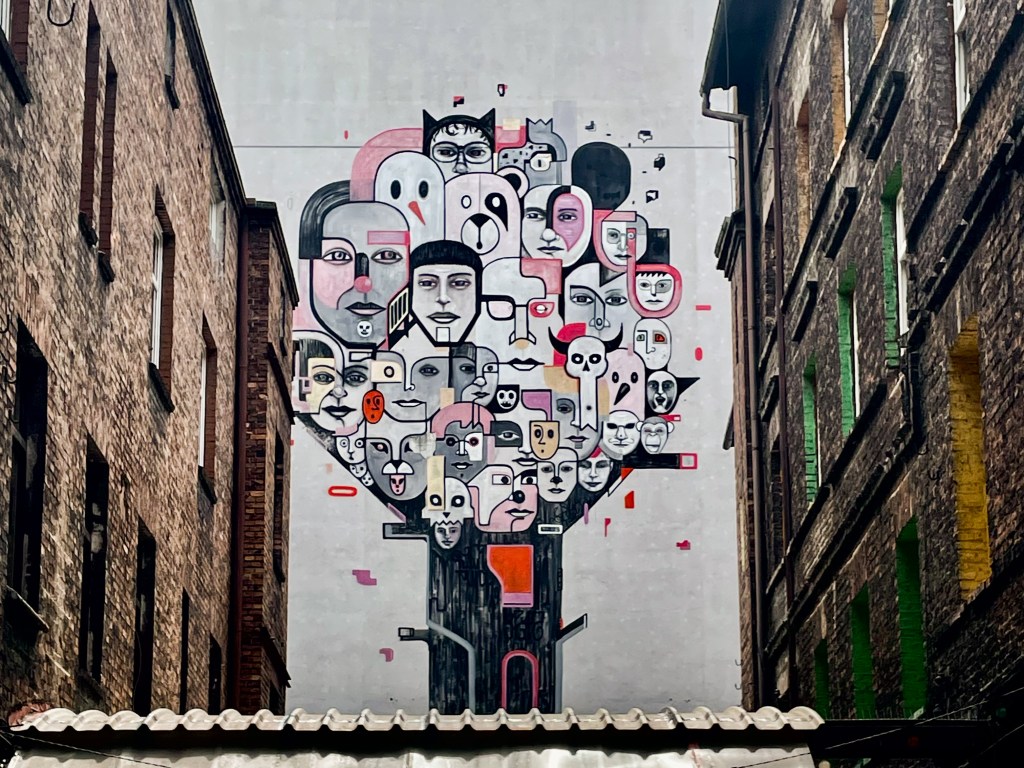
Raspazjan, ul. 3 Maja 38 (in the courtyard)
The next mural is a work of the Silesian artist, muralist and… magician (it is how he describes himself). Let me introduce Raspazjan. The mural was inspired by the natural wealth of the Silesian land and Silesian legends. The artists showed us the integration of Silesian cities forming a unity, in which there is a great force presented in the form of the idea of a tree and intertwining, connecting, strong roots.
Łukasz Zasadni, 3 Maja 23 (in the courtyard)
On this mural, the artist painted the Silesian “black gold”. What exactly is this type of gold? We are talking about the coal here! When we say Silesia in Poland, we think – COAL! This area has long been famous for the extraction of this resource and the development of the energy industry. It made a lot of profits in this region. Silesia even used to be the richest region of Poland during the interwar (1918-1939).
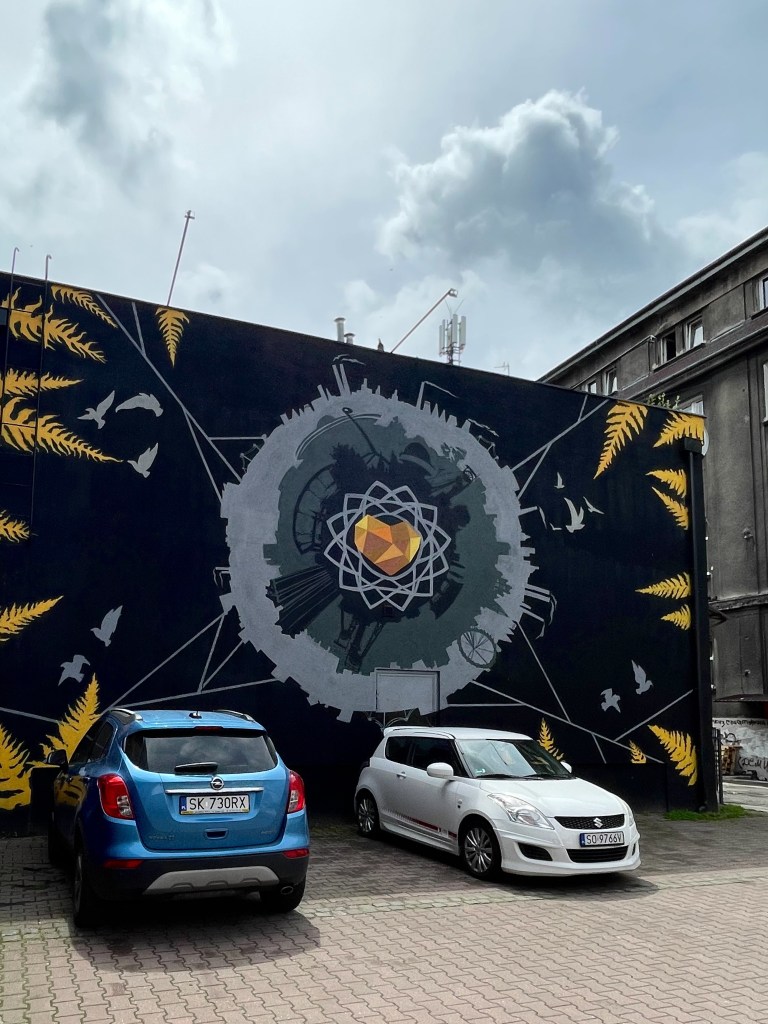
Mona Tusz, ul. 3 Maja 11 (in the courtyard)
Welcome to the courtyard of Stageless Theater’s building, which already has had a stage since 2016. The mural was created by an amazing Silesian street artist and painter – Mona Tusz. Katowice is full of her works, so you’re sure to come across them again. Mona creates not only murals but real street art, so you may come across her works absolutely by accident.
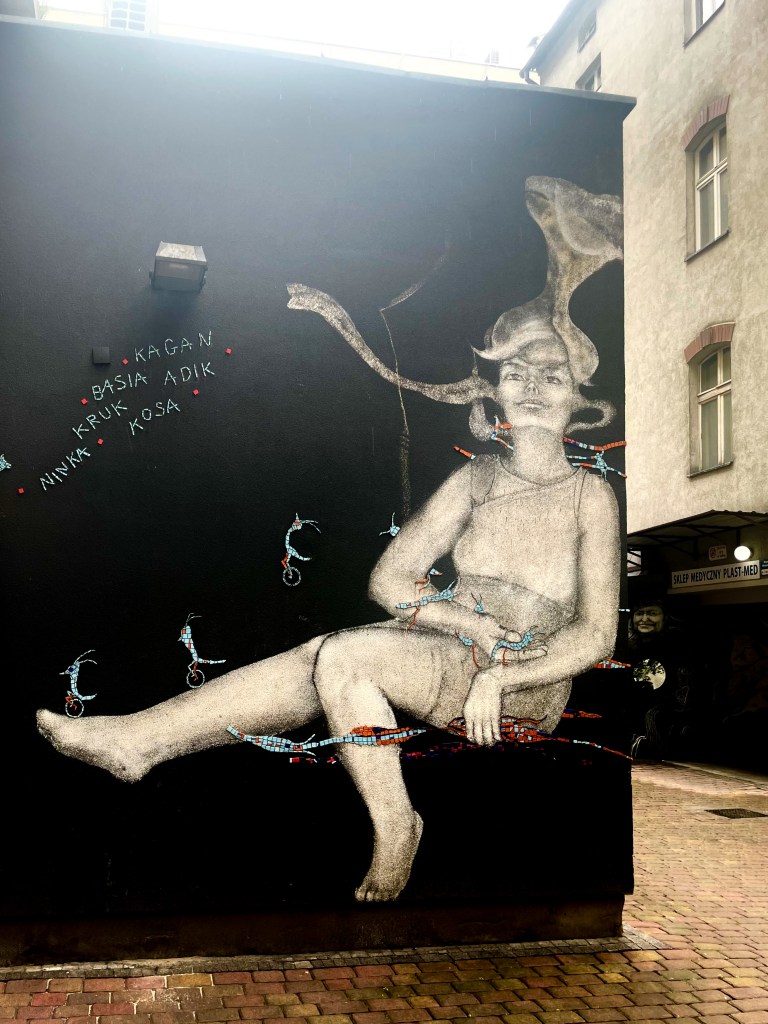
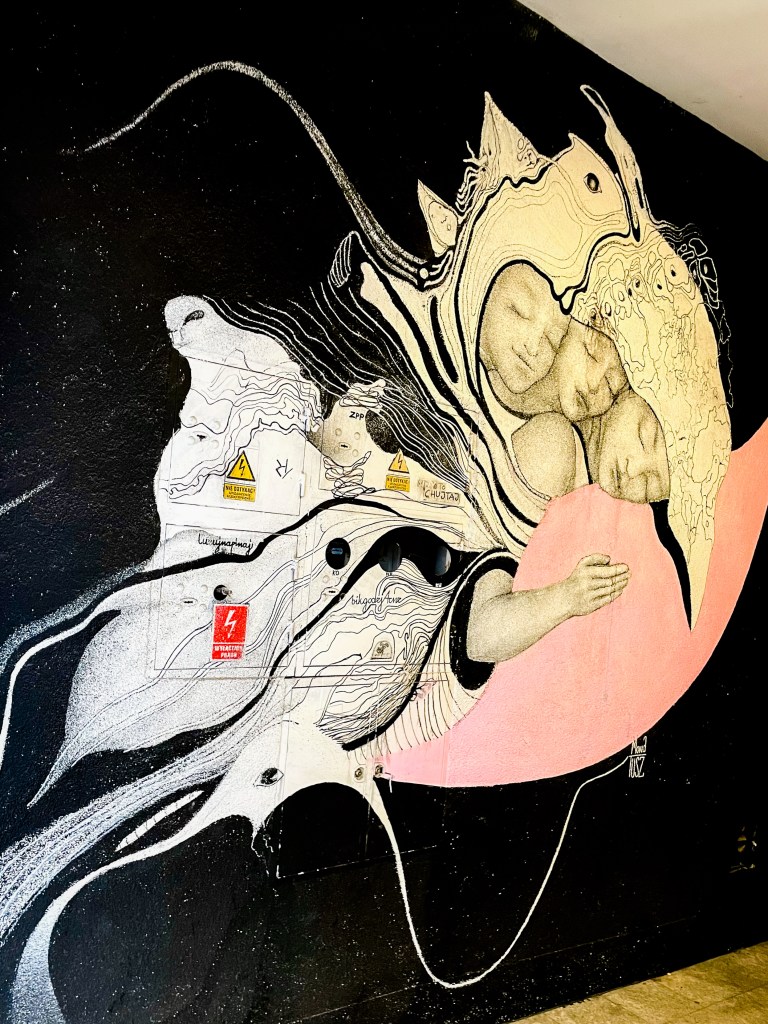
Mona Tusz’s works take us into an esoteric world of spirit and emotion, which is filled with biological textures and cosmic structures, as well as… mysterious creatures. Animals, plants, back to origins, Silesia region – this is how her style could be described in a few words. The artist wants to distract us from the reality and make us feel better. Is nice of her, isn’t it?
The mural of Zbigniew Wodecki (Polish musician) by Czary-Mury: Marek Grela & Marta Piróg, ul. Tylna Mariacka/Francuska
The story of this mural is unusual because at the beginning the concept of the mural was created and after that, the authors started looking for a wall to paint their project. As far as I read about it, they didn’t care about the city where the mural should be located because they were thinking about walls in different parts of Poland. In the end, the mural appeared in Katowice where the main character from the artwork spent his young years.
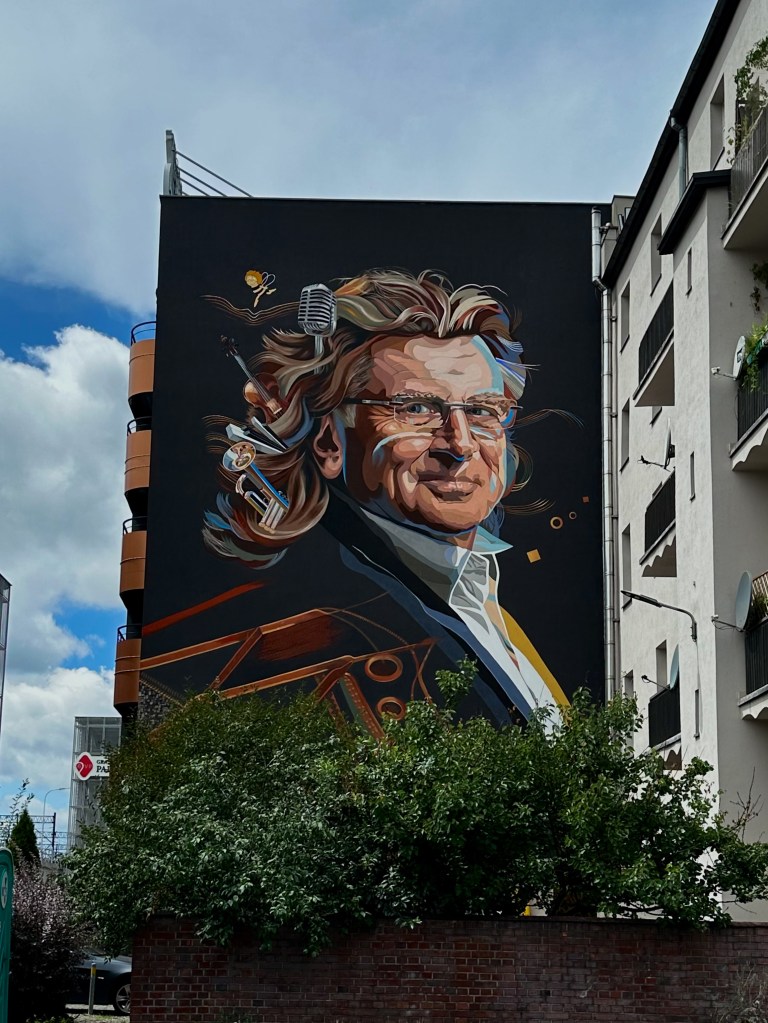
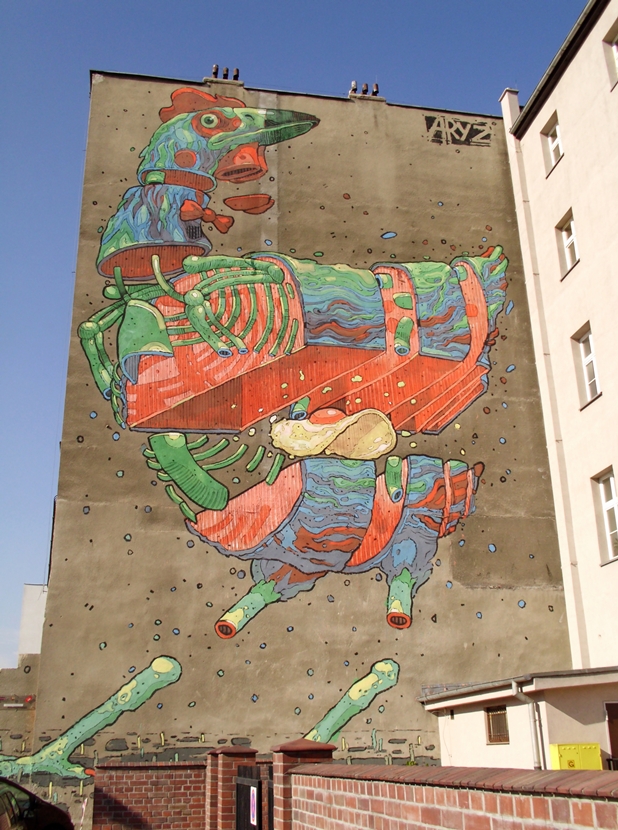
The sad thing is that before the portrait of Zbigniew Wodecki, Aryz’s mural was exactly on this wall. He painted an adorable hen here as a part of the Katowice Street Art Festival. I am not gonna lie if I say that everyone loved it! Unfortunately during the ongoing building renovation, Aryz’s mural was broken. The hen lost their head. The building owner declared even that the mural would be repainted (interesting idea) but nothing like that happened. Finally, they decided to create another mural on this wall.
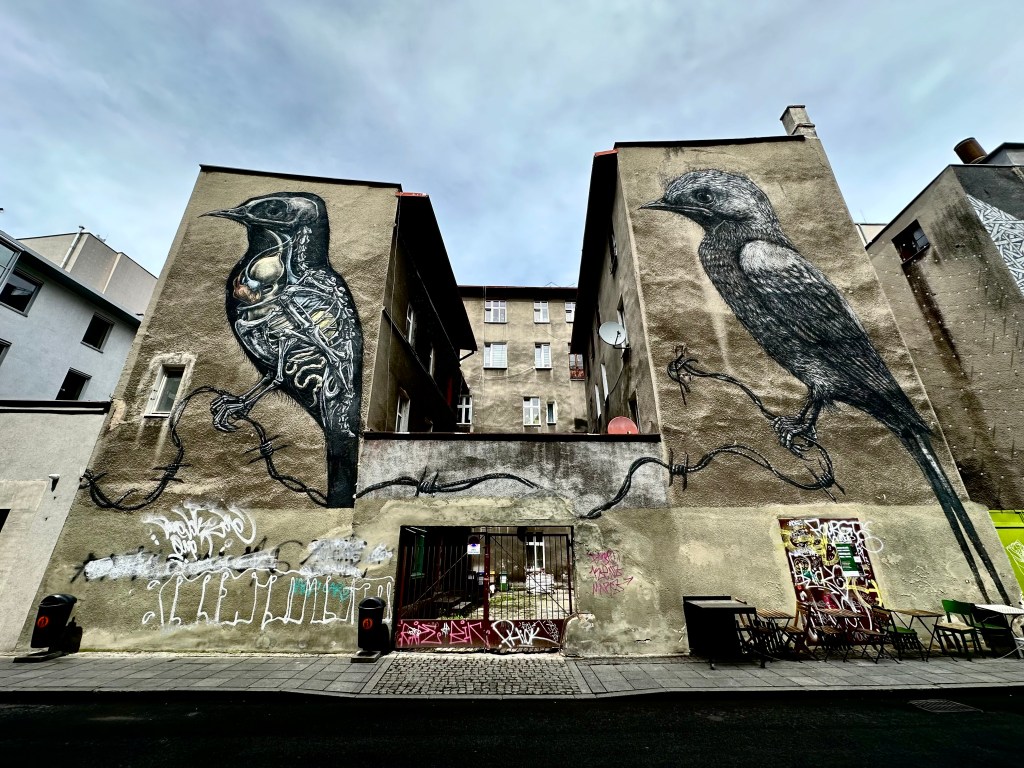
ROA, Mariacka Tylna 19
How lucky the people of Katowice were! ROA created for them not one mural but two! Or… one mural but on the two walls. You can find them on Mariacka Tylna Street. One of them looks like a typical bird, another shows us what the bird has inside.
Moneyless + Tellas, Mariacka Tylna 13
Close to the ROA, you will find the mural created by two Italian artists – Moneyless and Tellas. They normally work separately but because of the second edition of the Katowice Street Art Festival, they joined forces. Looking at this work, I just want to add that the real beauty lies in simplicity!
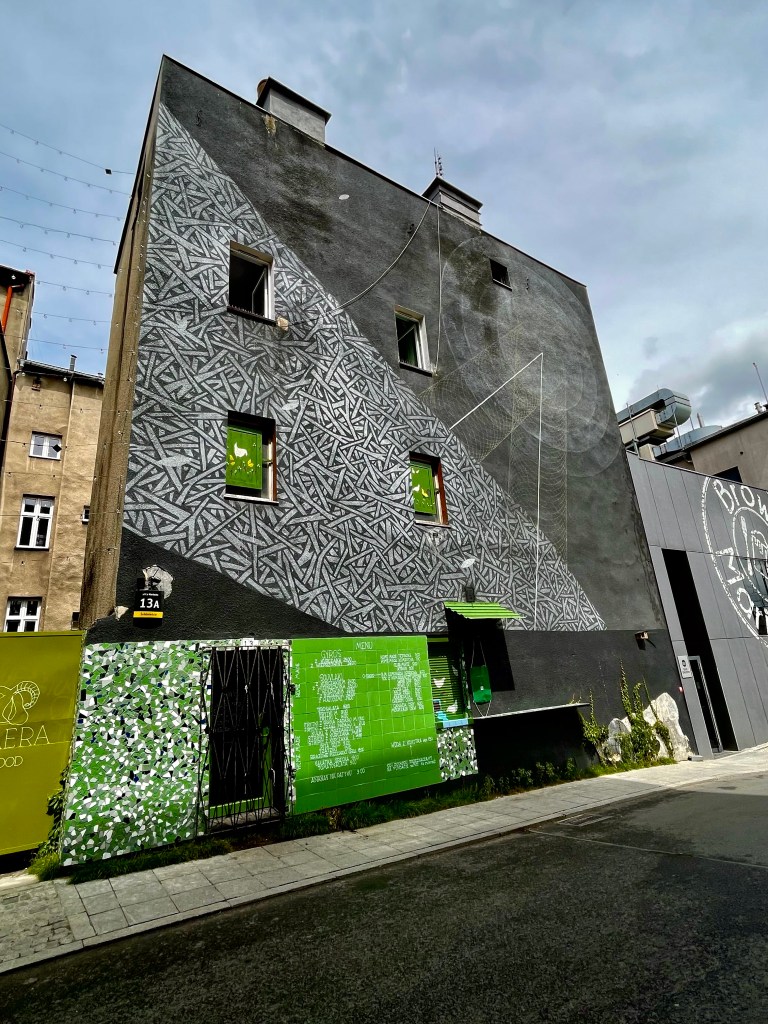
They painted another mural you could find not so far from there.
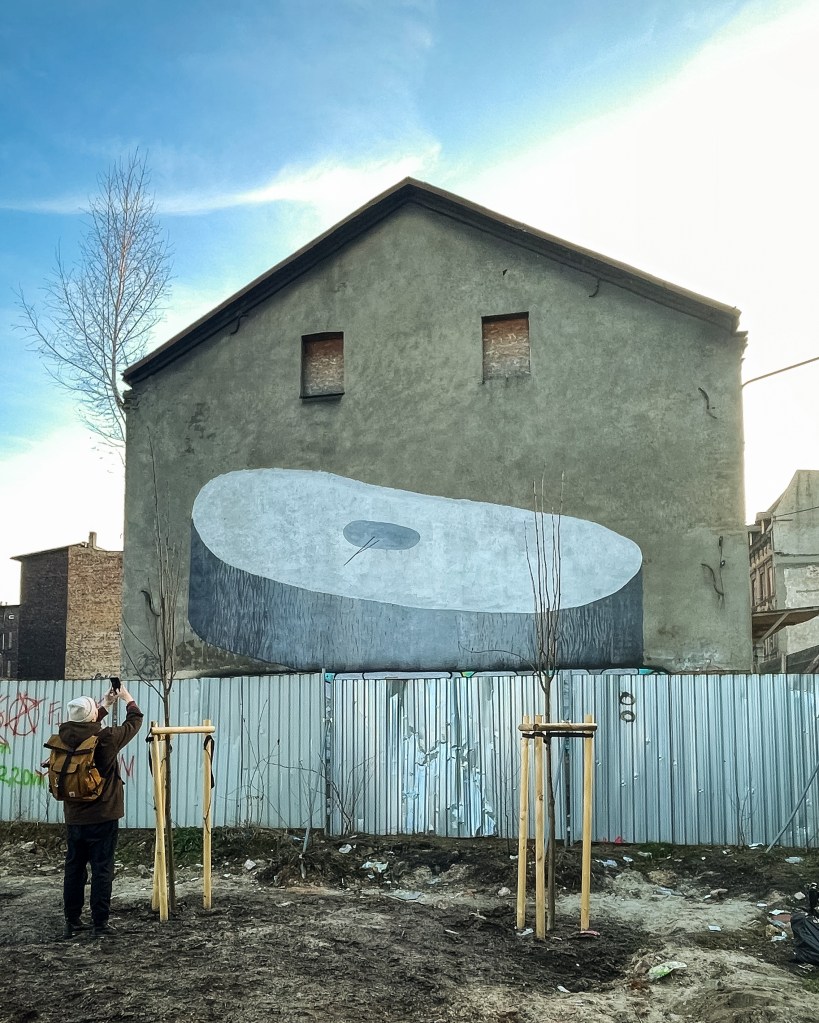
Karol Kobryń, Mariacka Tylna 1A
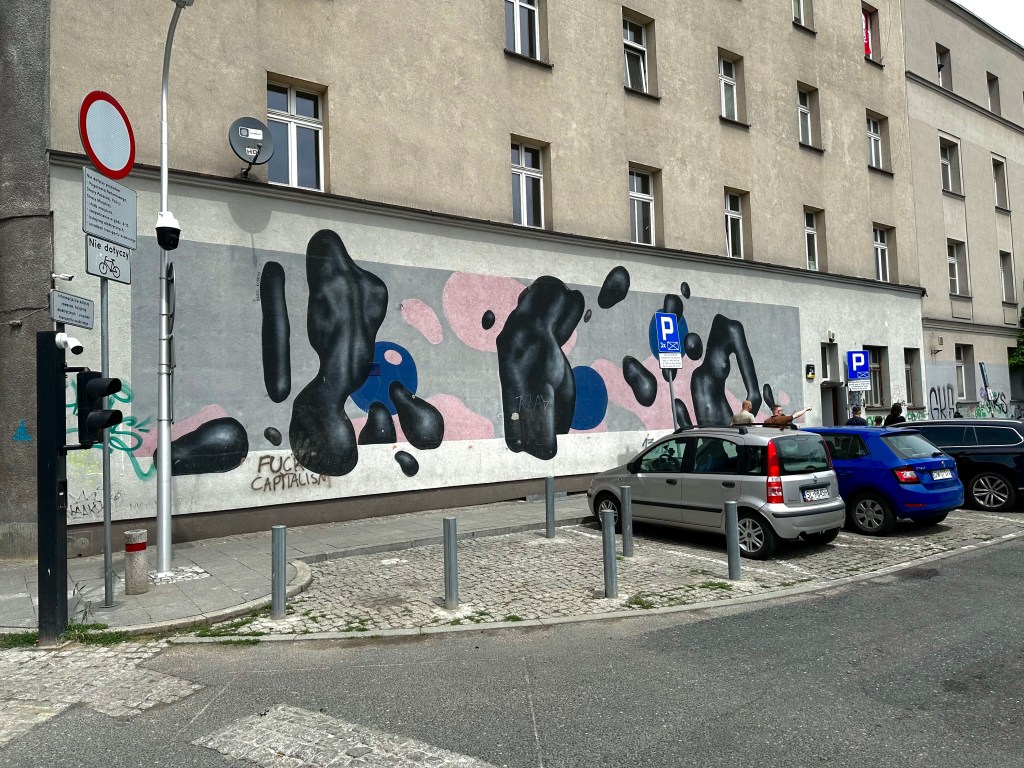
These stains make sense! This is a study of the body created by Silesian artist Karol Kobryń. Before the mural, the wall was full of tags and football slogans. The artist didn’t like it so much and he asked the community if they didn’t mind if he painted over it. They didn’t, and what’s more, they provided Kobryń with materials for the work.
Mural of Krystyna Bochenek, NIETAK Group (Łukasz Zasadni), Wojewódzka 48a
The woman who looks out at us from this mural is a Silesian-born politician. She is known for her “Chairs for Learning” initiative which aimed to support talented, but financially disadvantaged, students. The chairs, donated by sponsors, were repainted by various artists. After the renovation, the chairs were sold, and the profits from the sale went to student scholarships.
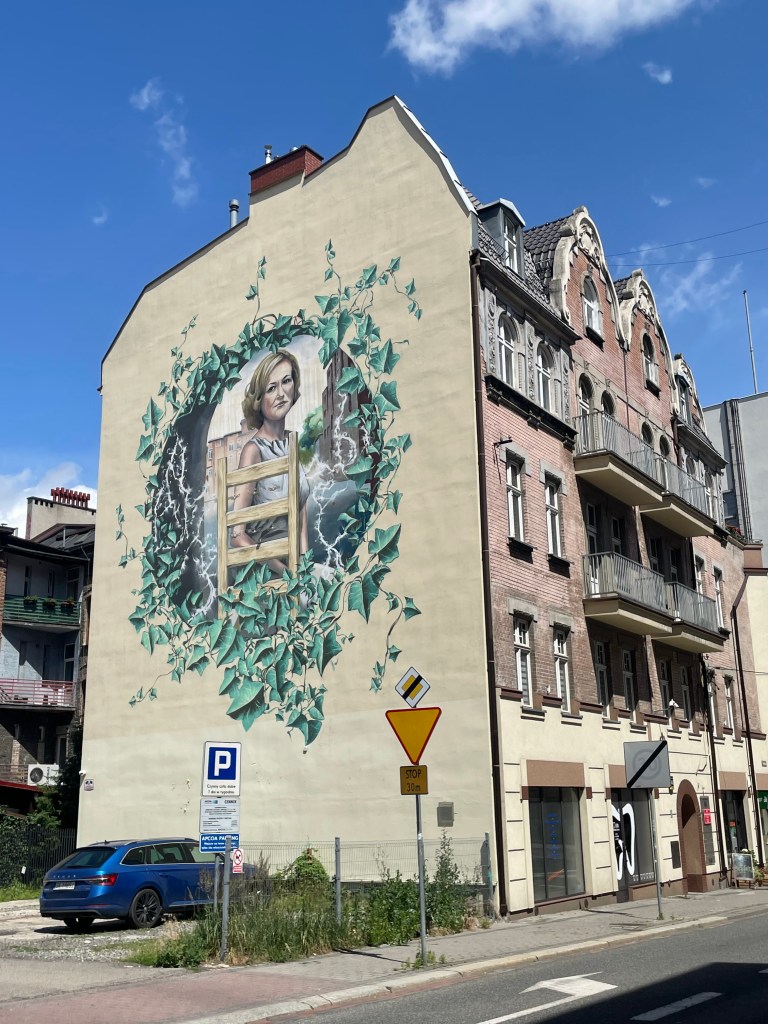
The creator of the mural – Lukasz Zasadni – had the pleasure of restoring one of these chairs. He also placed the chair in the mural, which I think is a lovely gesture.
Raspazjan, Kordeckiego 2
I’ve already written about Raspazjan above, so let me tell you something more about the work from Kordeckiego Street. The mural depicts a man in a pot, surrounded by… an ecosystem of which he is an integral part. He is drawing from its resources, however they are limited – like the ability to grow roots in the pot. His (and our) way to survive will be to use energy from renewable sources.
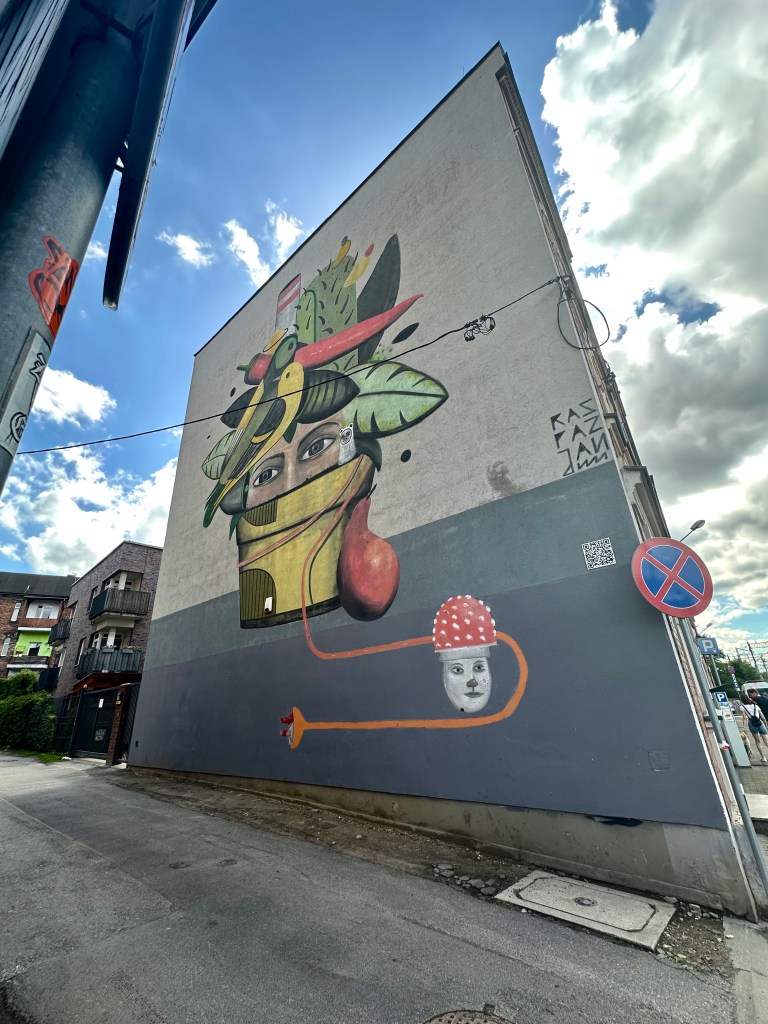
Besides the rich metaphor, there is also another interesting story related to this mural. The artist admitted that this was one of the most challenging murals. Not because of the mural subject, but the weather. The work was created during temperatures of minus 6 degrees Celsius and also in a snowstorm. The critical moment was when Raspazjan’s paints froze. However, the artist and the mural are fine now.
Playground by CHAZME 718 & SEPE, Drzymały 22
I love Chazme and Sepe’s works! They are so fascinating. Their mural in Katowice refers to the huge amount of cars in the city. Sepe and Chazme wanted to show that gardens in Katowice can only be established on rooftops because other locations are just parking spaces. It’s characteristic of Polish cities – they are full of cars and parking.
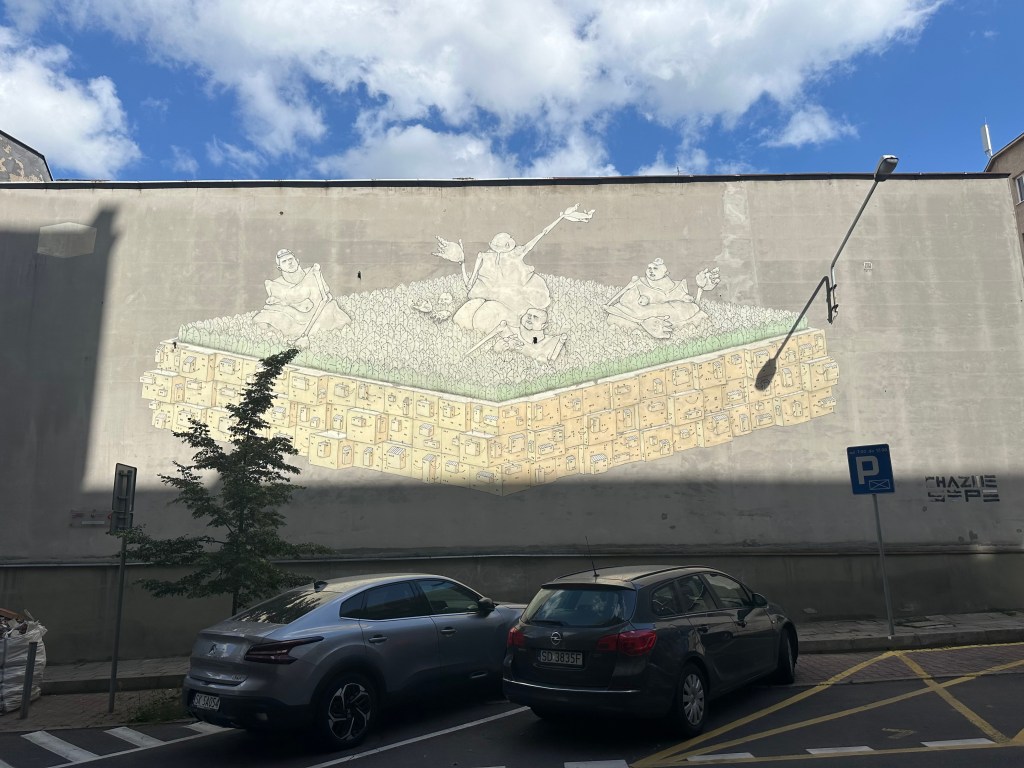
The funny thing is that the mural did not go unnoticed by the city council. And not because of the cars. Some councillors were disturbed by the fact that the figures from the mural were chubby and naked. They even wanted to get rid of the work but the mural fans didn’t allow them to do it.
MCity and Szwedzki & Real
Besides the murals I mention above, there are two more murals in Śródmieście area. One of them is a large work by M-City. Mostly covered by ivy. The other one, smaller, is a commentary by a local artist Szwedzki and Real on the situation in Eastern Europe. I have already written about them HERE.
Check out the MAP where you find all murals in Śródmieście.
Street Art in Katowice: Osiedle Paderewskiego
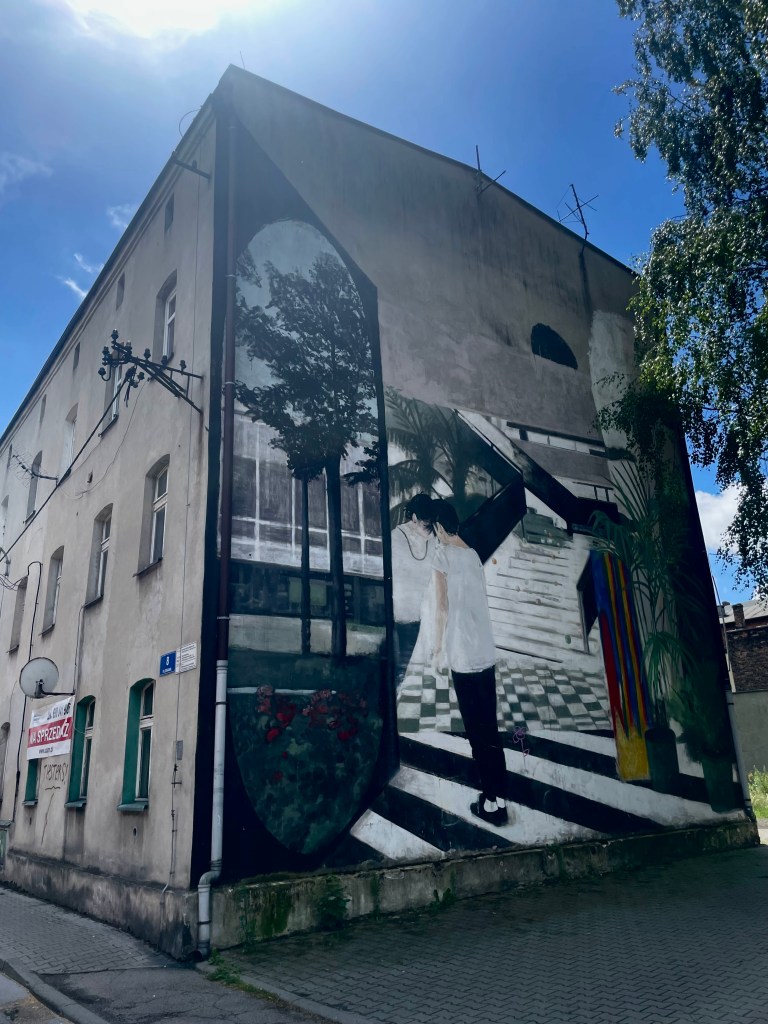
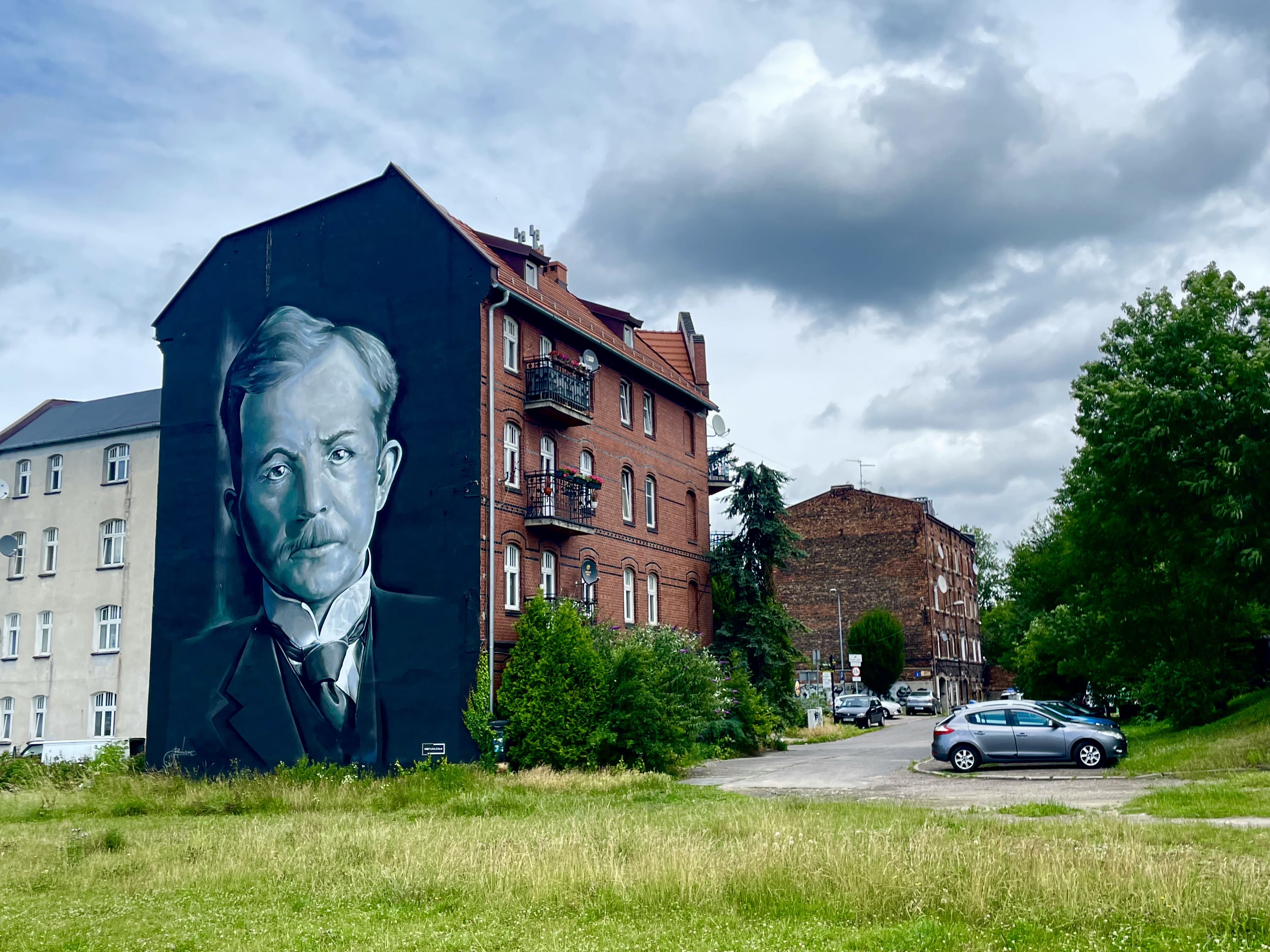
I went to this part of Katowice to see ZBIOK’s mural, which was created as part of the Katowice Street Art Festival in 2013. The mural shows the Palace of Vows, which was demolished by the city of Katowice. Even without context, I could feel that the mural was telling a story about something sad. And it was the right feeling because the mural was part of the Black Gold series. The main goal of this series was to tell the story of the old treasures of the city of Katowice in a post-modern approach.
ZBIOK, Floriana 8
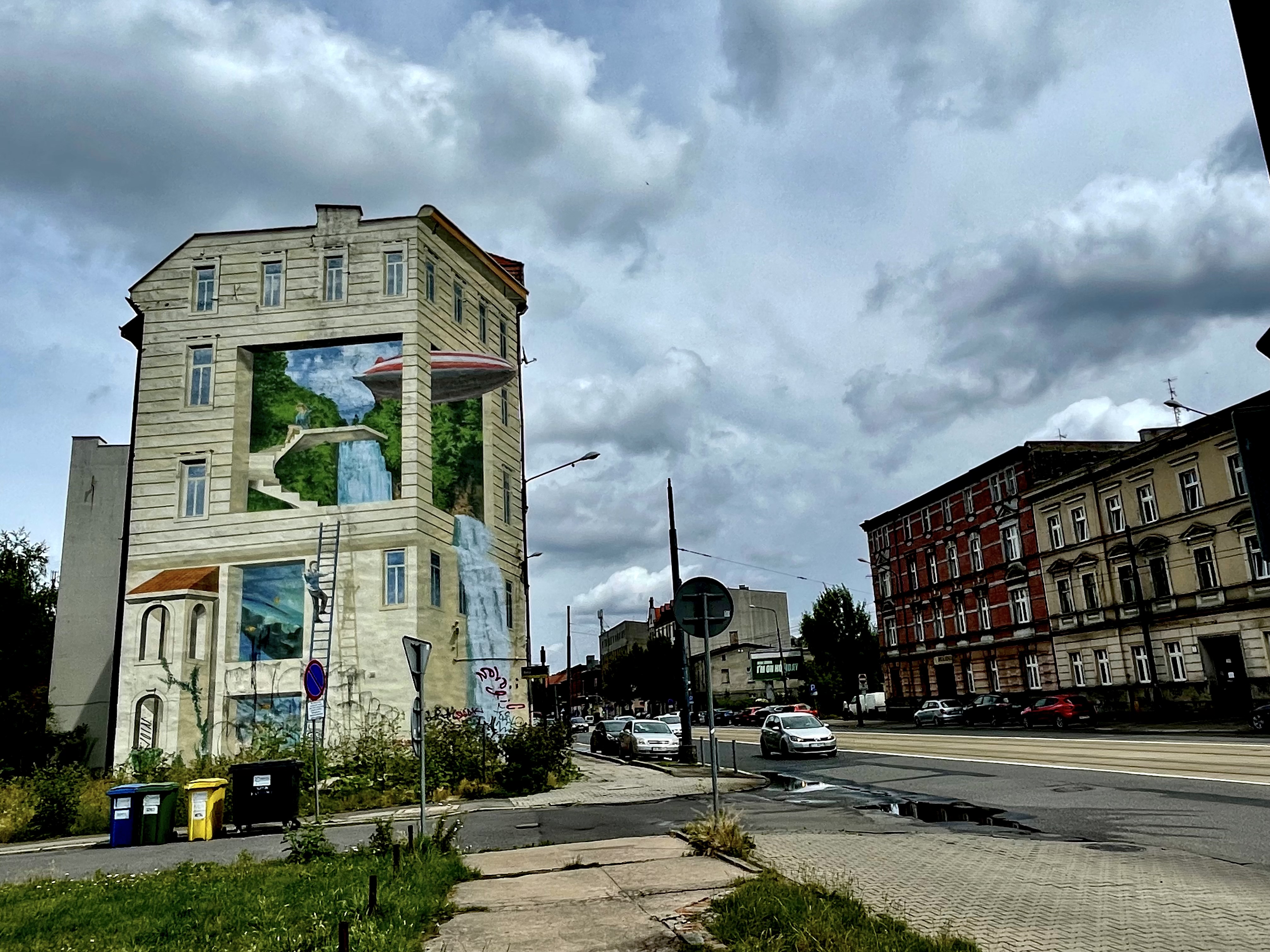
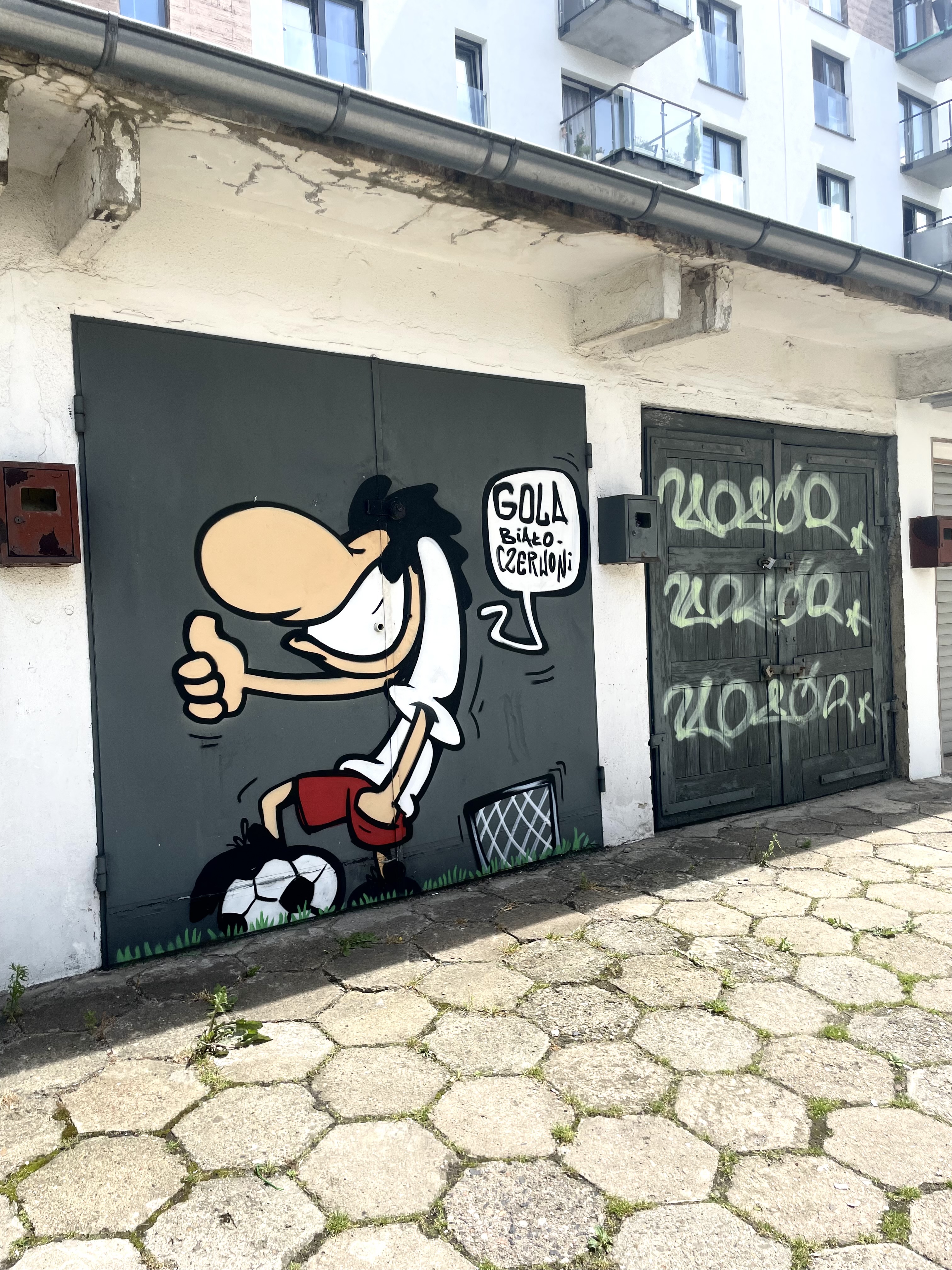
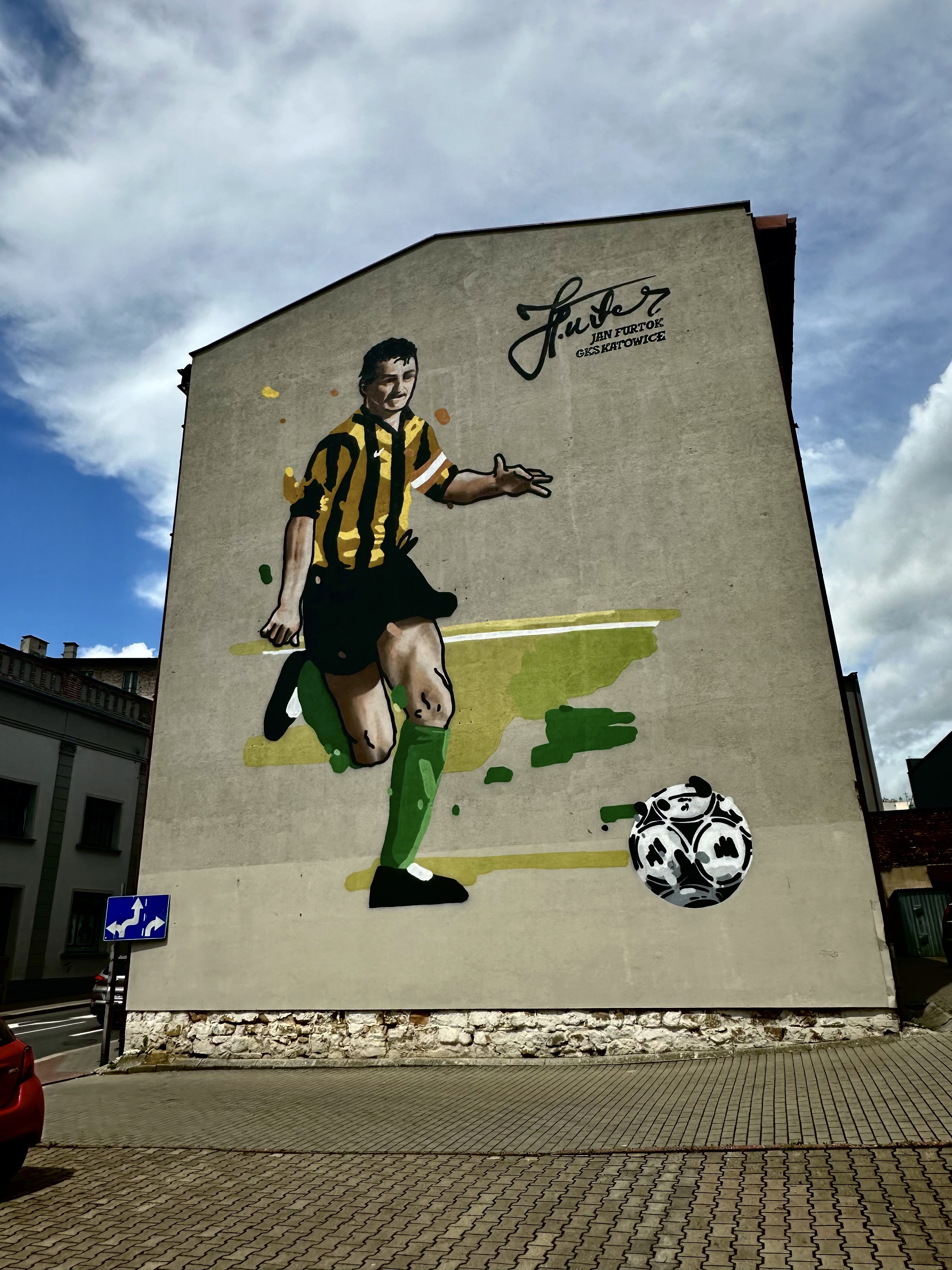
By the way, I saw three other murals – a historical (and controversial figure), a football player and… an airship. You can find their locations on the map.
Street Art in Katowice: Załęże
Well, Załęże could be a little bit disturbing. It has a bad reputation. But for me, it wasn’t so bad here. I didn’t feel unsafe. I would even say that time stops here instead. You see here a lot of familoki– a type of multi-family house, designed for coal miners and their families. If you don’t make a fuss around yourself and respect the residents, everything will be ok, and you’ll see some exceptional murals.
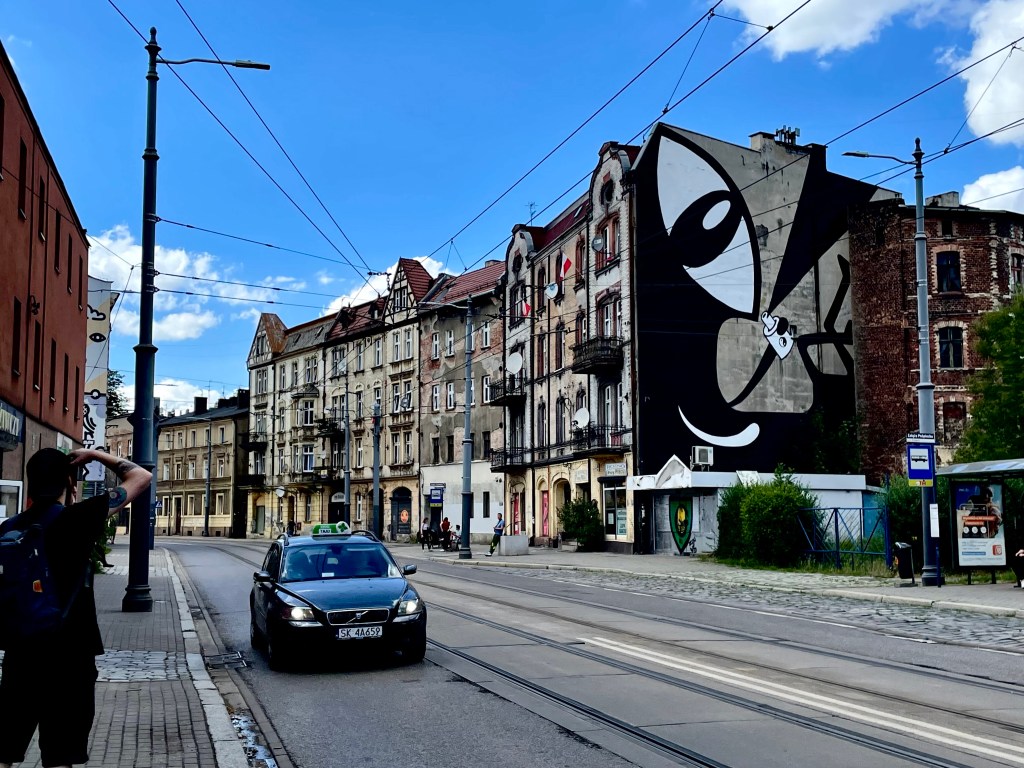
The Watcher by Noriaki, Gliwicka 73
Do you recognise a figure from this mural? You should! Noriaki is known for putting his “watchers” everywhere in the world. But this time, the Watcher took over an entire wall and “winks” at passersby.
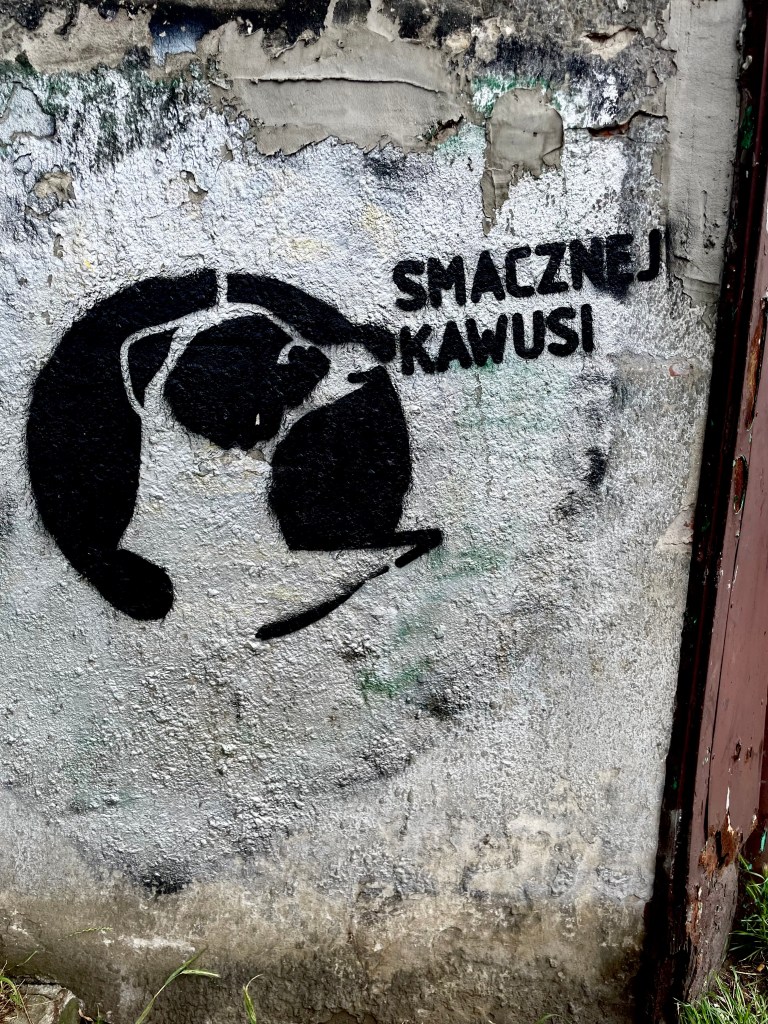
Not far from the mural, just across the street, you can find the work of Warsaw street artist Bart Sucharski.
Hyuro, Gliwicka 60
This mural was one on my “must-see” list. This artist, born in Argentina and then active in Valencia, created murals reflecting her thoughts and concerns. The mural was created in 2012 as part of the Katowice Street Art Festival.
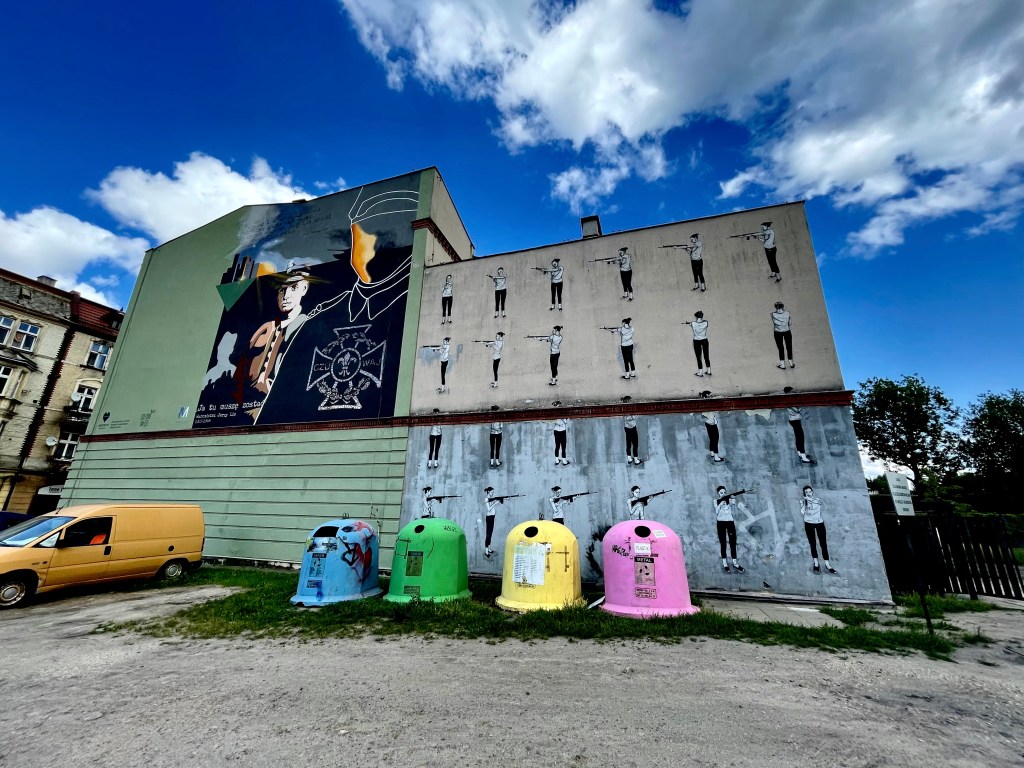
Right next to Hyuro’s work, on the building next door, you’ll find a classic example of the use of a civic budget, a mural relating to history. The mural was created in 2023 and depicts Scoutmaster Jerzy Lis, who was executed in Auschwitz during World War II. The author of the mural is the duo Czary-Mury.
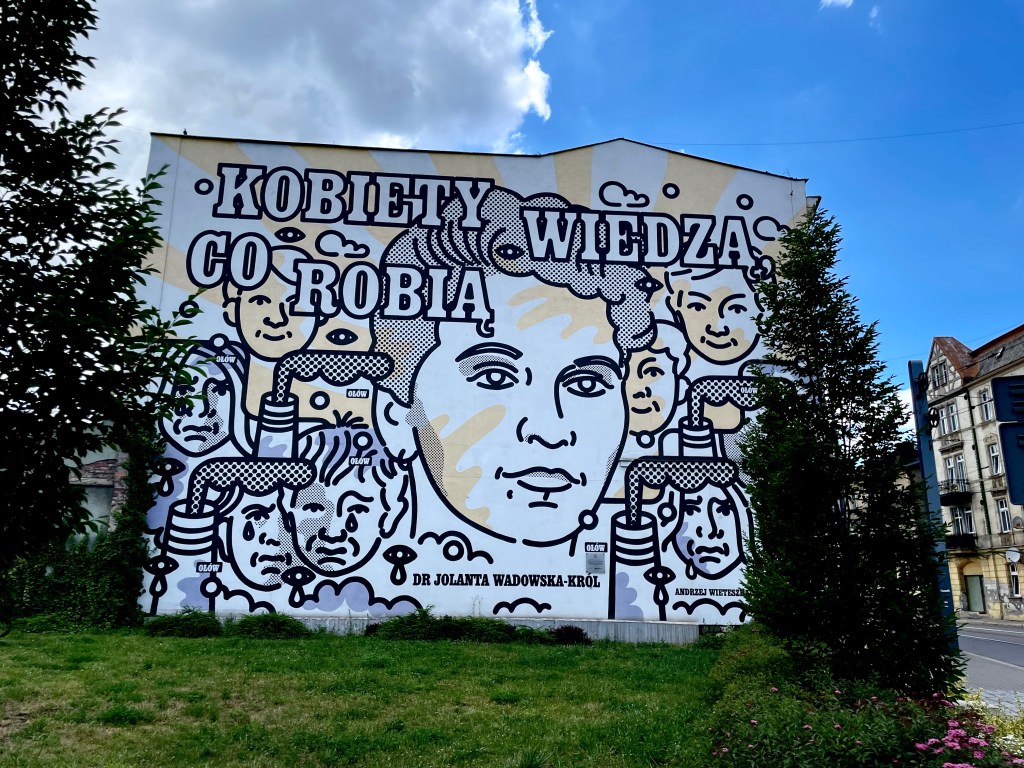
Women Know What They’re Doing by Andrzej Wieteszka, Gliwicka 56
Opposite Hyuro you’ll find a mural with doctor Jolanta Wadowska-Król, who used to save people from lead poisoning.
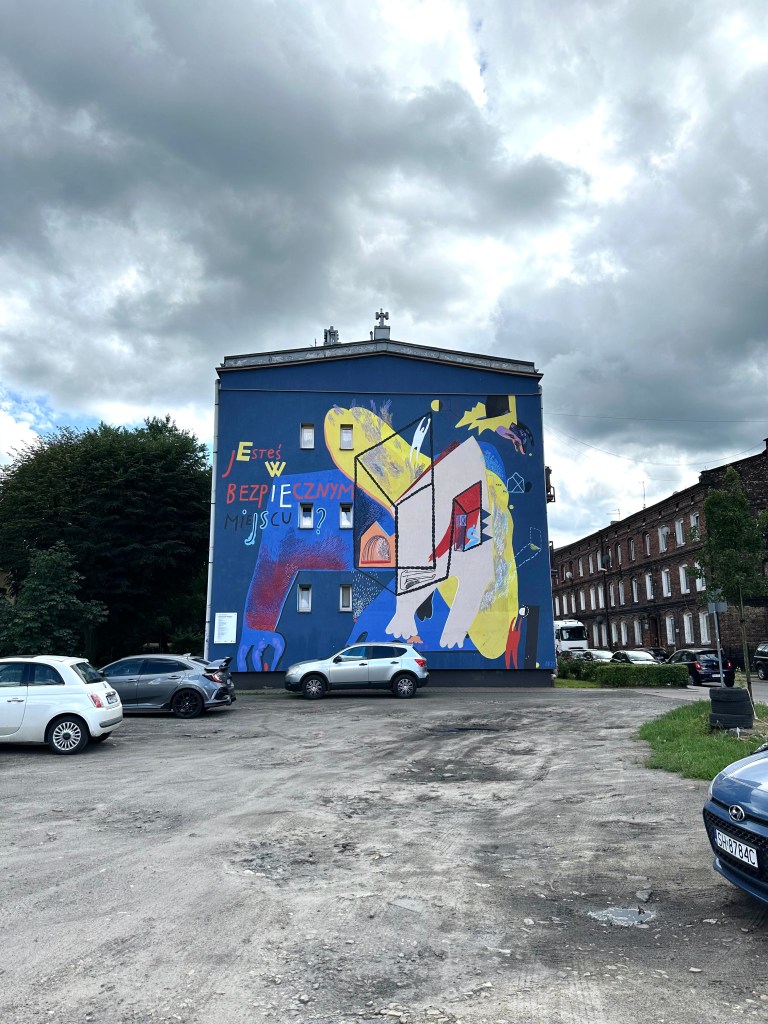
Safe Place by Bogdana Davydiuk, Macieja 3
The mural refers to the poem with the same title. This work was a gesture of support for Ukrainian artists during the war in Ukraine.
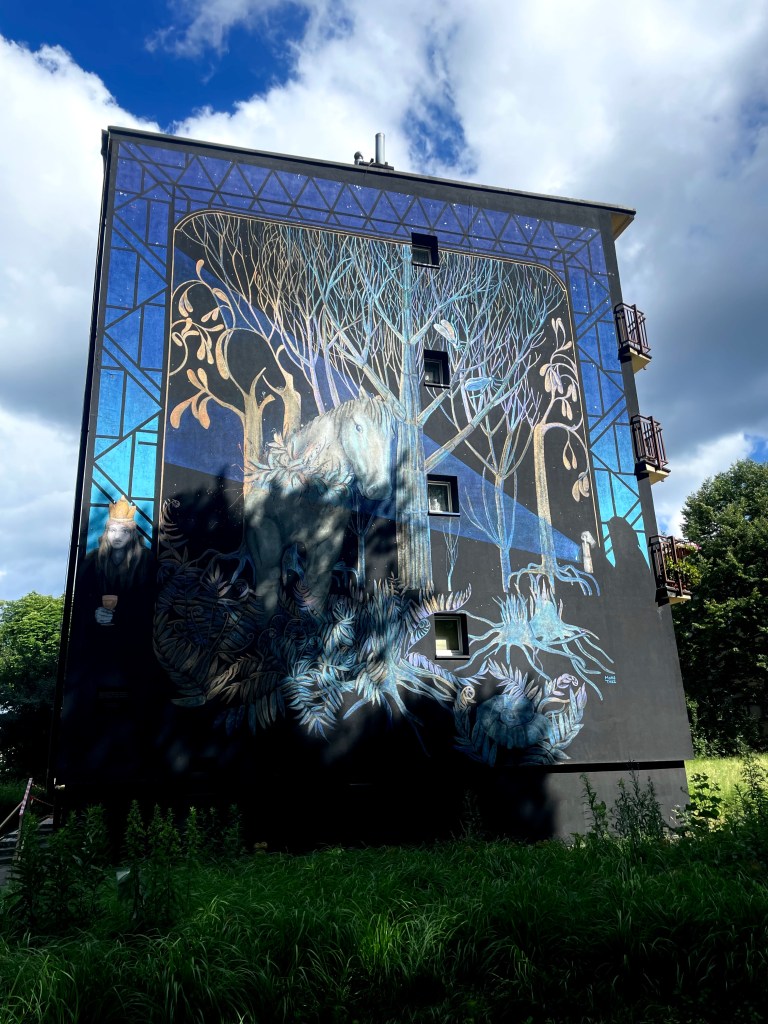
Mona Tusz, Gliwicka 130C
Mona Tusz’s art in large-format edition is so impressive. Just look at her mural from Gliwicka Street. It was inspired by the spectacle “Lysek z pokładu Idy”. It’s a story about a clever horse that worked in a mine. In the past days, it was common for the animals to work in coal mining. The good thing is that these days are behind us. At least in Poland.
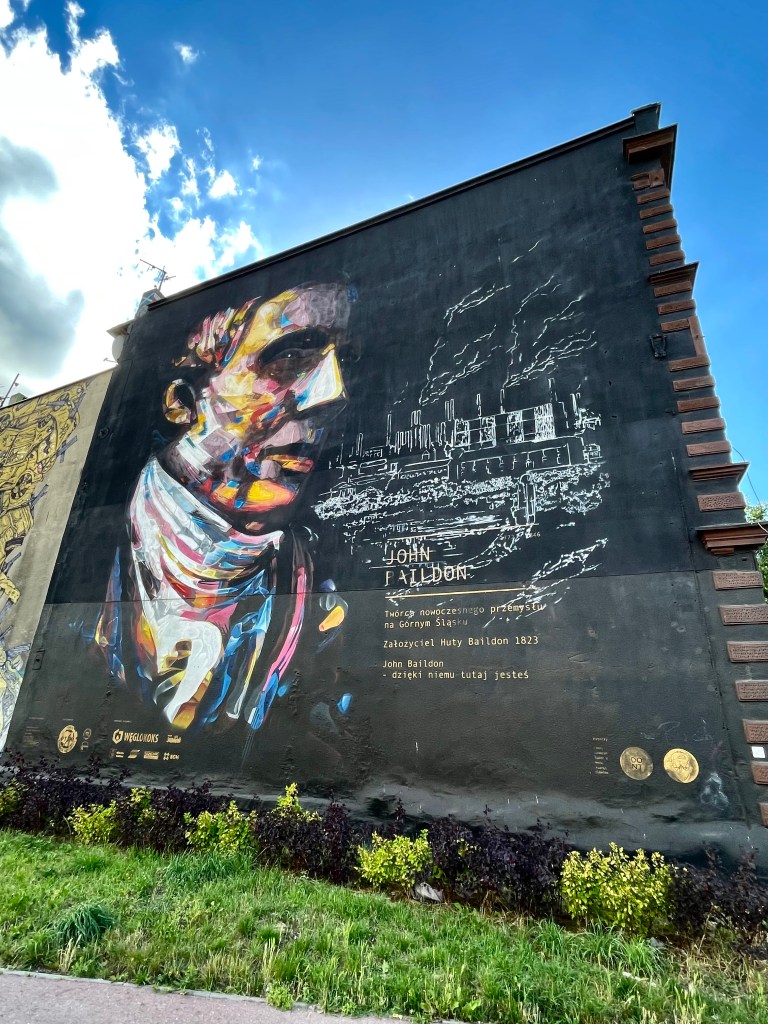
Mural of John Baildon, 146 Gliwicka St.
Mural created in honor of John Baildon, an industrial-revolutional man in Silesia. The project was created by the studio of Jakub Wisniewski, and painted by CamCamej.
Miko Skapa, 146 Gliwicka St.
Another mural was created during the Katowice Street Art Festival. This one is from 2015. In his work, the artist refers to over-consumerism and the lack of reflection on its consequences. The work fits beautifully into a long and burly wall.
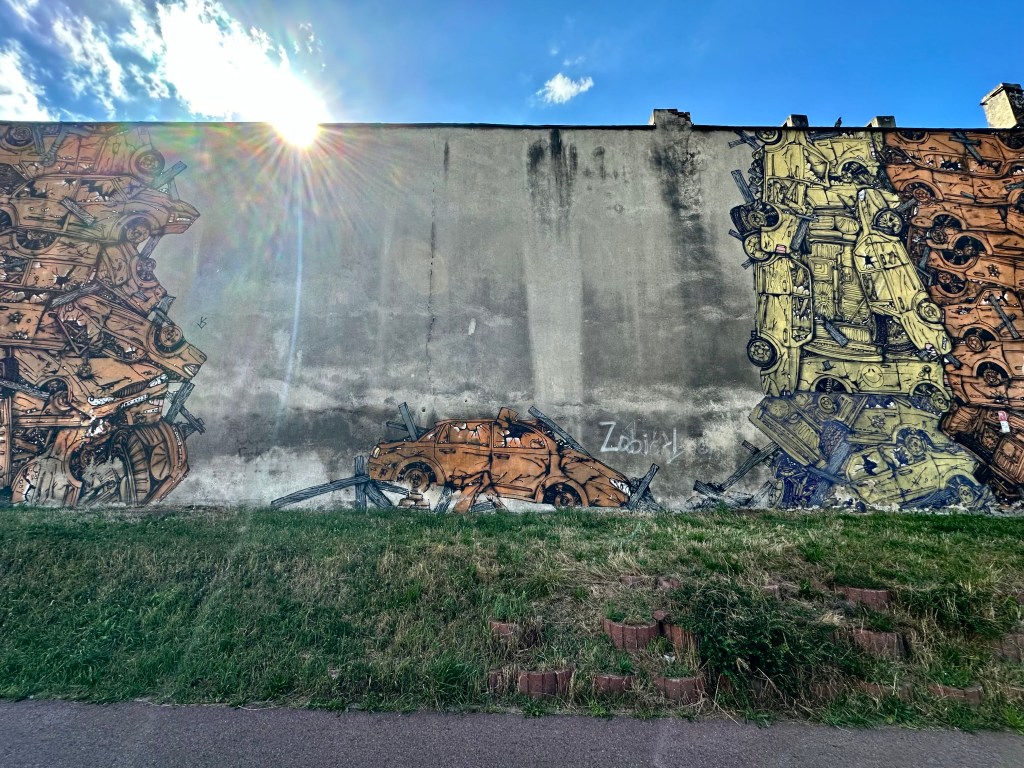
Mona Tusz & Raspazjan & Kids, Dom Aniołów Stróżów, Gliwicka 148.
The appearance of Dom Aniołów Stróżów (House of the Guardian Angels) – a community center – is a credit to the Katowice Street Art Festival. In 2011, the organizers invited to project Raspazjan and Mona Tusz. Together, the artists and the kids from Dom Aniołów Stróżów created and painted the walls of the building.
Łukasz Surowiec, Kupca 14
Another mural that I was curious about. Lukasz Surowiec knows how to deal with emotions which he confirms with his art. In Katowice, he created a mural for the Katowice Street Art Festival in 2015. This mural was special because he transferred to the wall a drawing of an 8 year old girl. This was a drawing of the author herself, her grandpa and her dad. Important here is the time when the girl draws her work. It was a while after the protests of miners in Silesia. In the picture, the miners are in black, because this is how you look when you leave the mine. And why are the figures smiling and crying at the same time? As Zosia (name of the author) herself says, the reason is her mistake. This mistake made Łukasz Surowiec decide to move the picture to the wall.
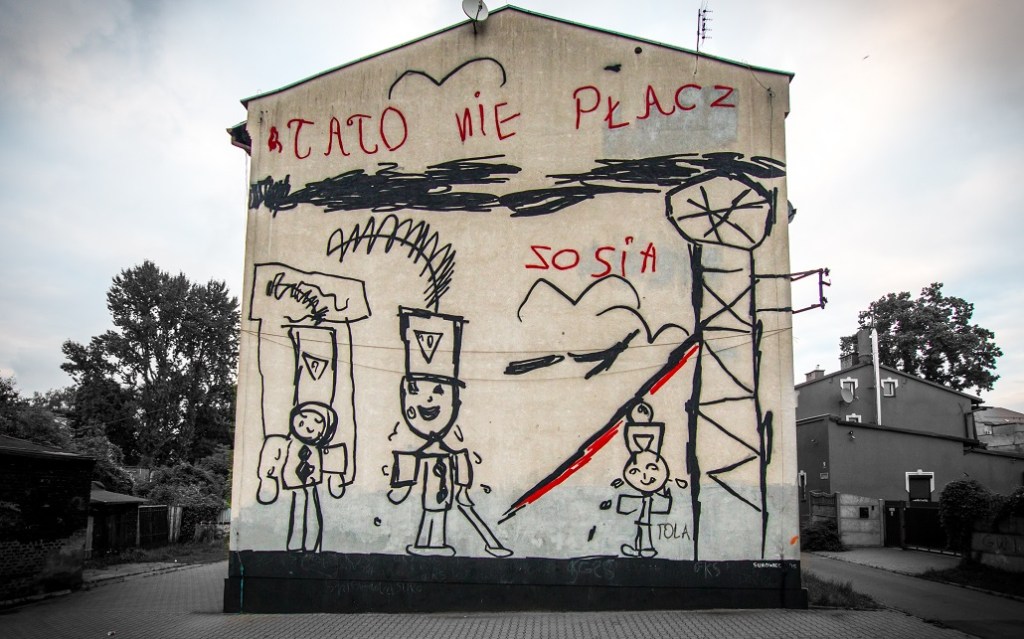
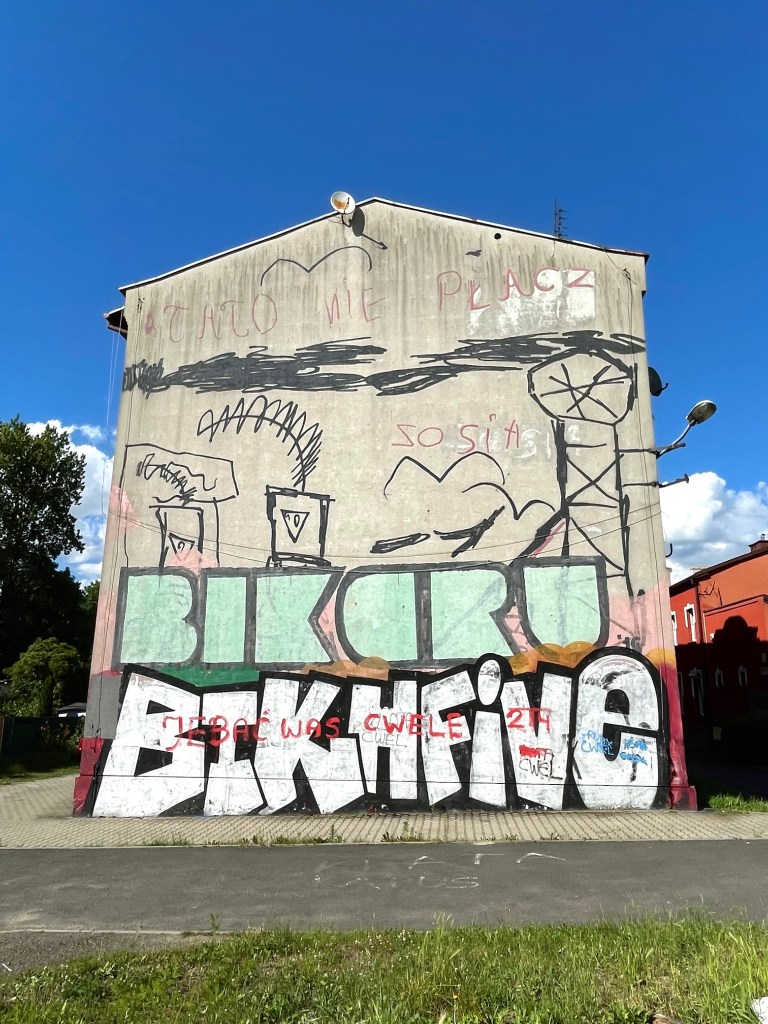
Today, unfortunately, we can’t see the whole mural because of the tags and graffiti that appeared at the bottom of the work. Nonetheless, I encourage you to check it.
Mobstr, 3 Lelewela Str.
A lot of excellent works appeared because of the Katowice Street Art Festival. When we are thinking about murals nowadays, whether sponsored by companies or by the civic budget, the KSAF activity was a different league. Their murals weren’t simple and polite. Instead, they invited artists who made their comments, even though the comments were controversial.
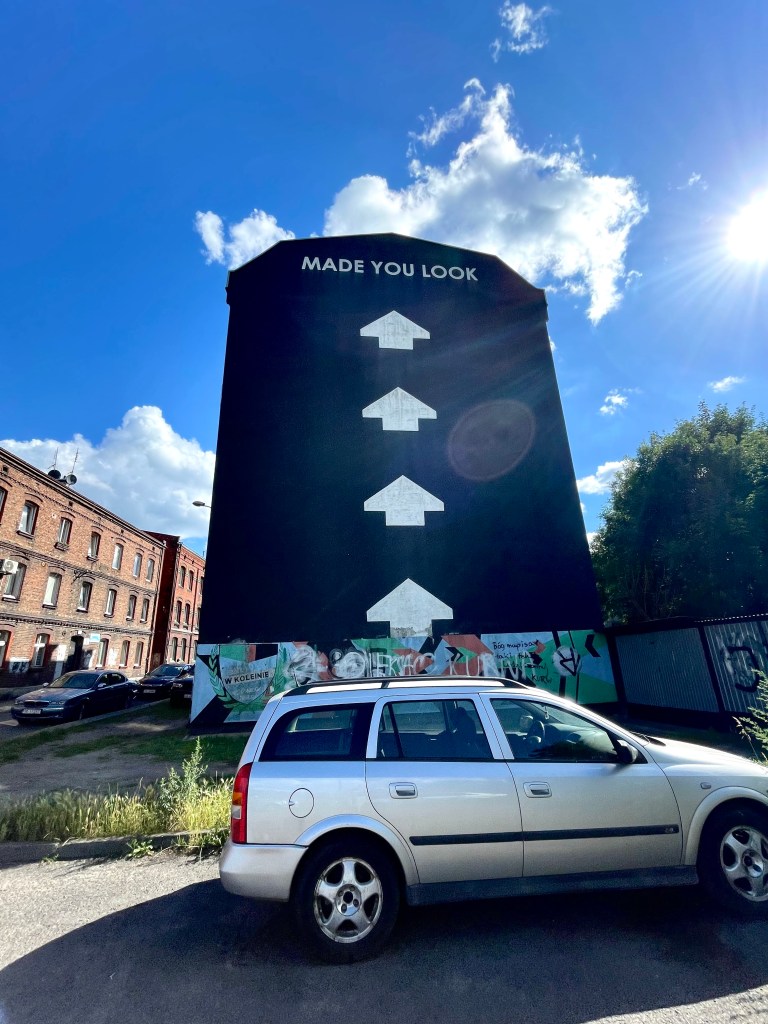
One of the very works that made me write that the Katowice Street Art Festival was one of the best things that happened to Katowice is the work of British artist Mobstr. By using stencils and a simple slogan, Mobstr asked us how we perceive urban space, legitimate advertising stuck in it and those polite “street art”.
Street Art in Katowice: Koszutka
Koszutka is one of the smallest districts in Katowice. It is also the place where the amount of oldest habitants is the highest Still, you’ll find a lot of interesting murals here, including Escif’s amazing work.
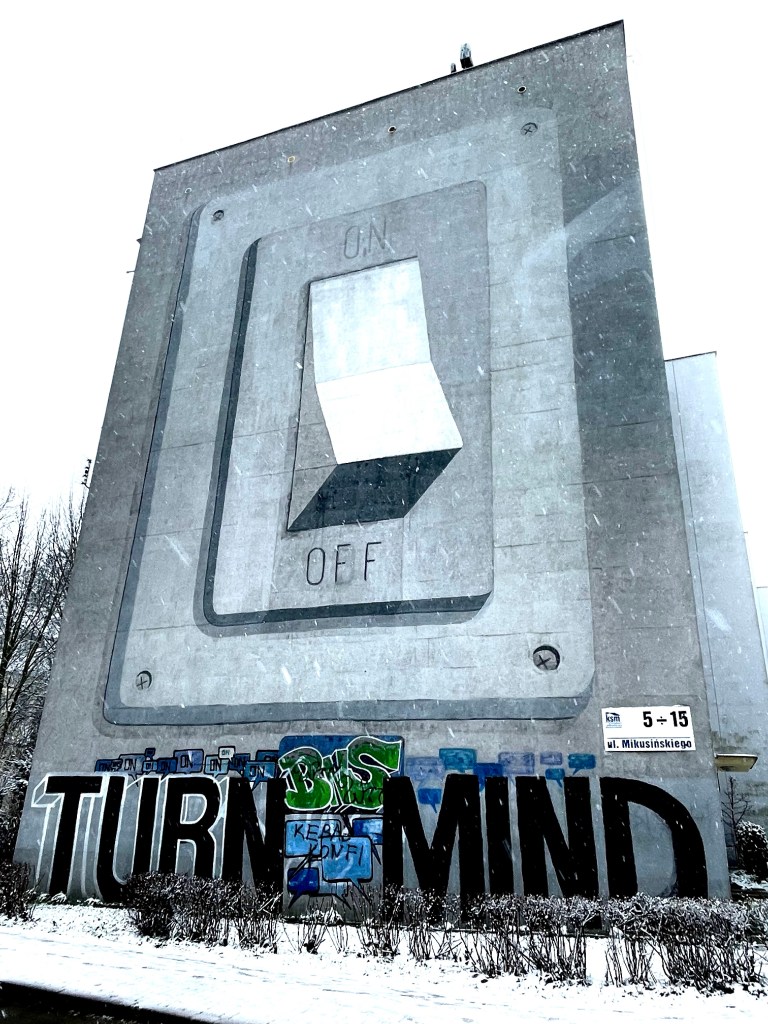
I wrote more about this district here.
Street Art in Katowice: Zawodzie
You’ll find some well-preserved murals in this pretty well-communicated part of the city. However, I recommend walking to Porcelanowa Street to the Porcelain Factory, where you’ll not only find a series of murals created for the Street Art Festival Katowice, but also a factory complex with interesting architecture.
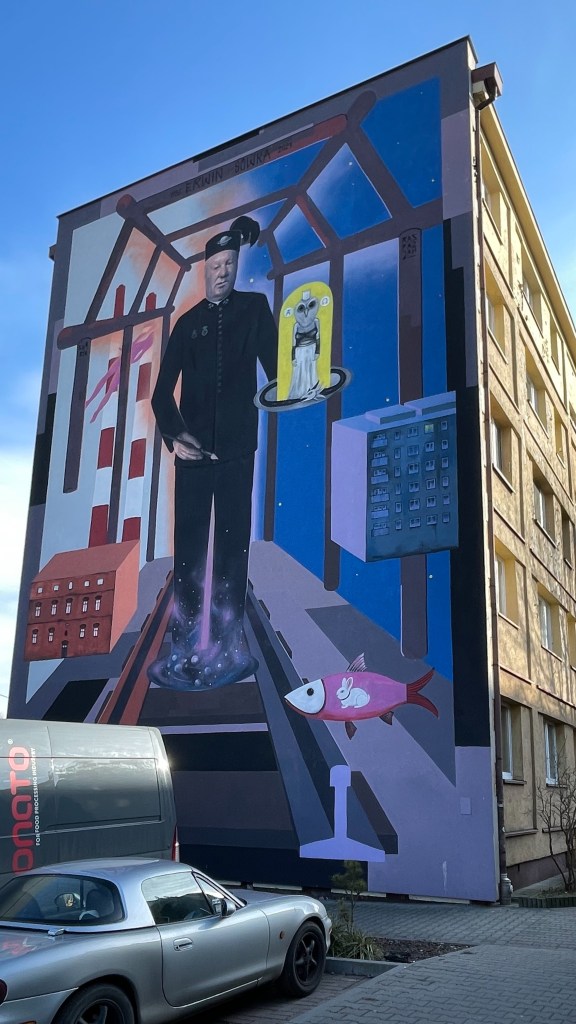
Erwin Sówka by Raspazjan and Karol Kobryń, 1 Maja 162 street
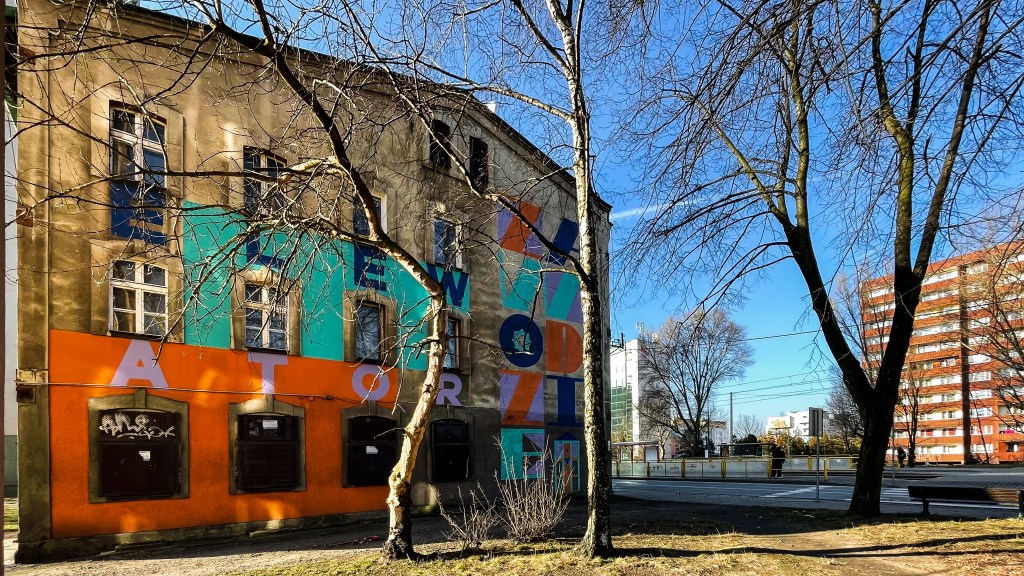
Paweł Ryżko & Karol Kobryń, 1 Maja 154 street
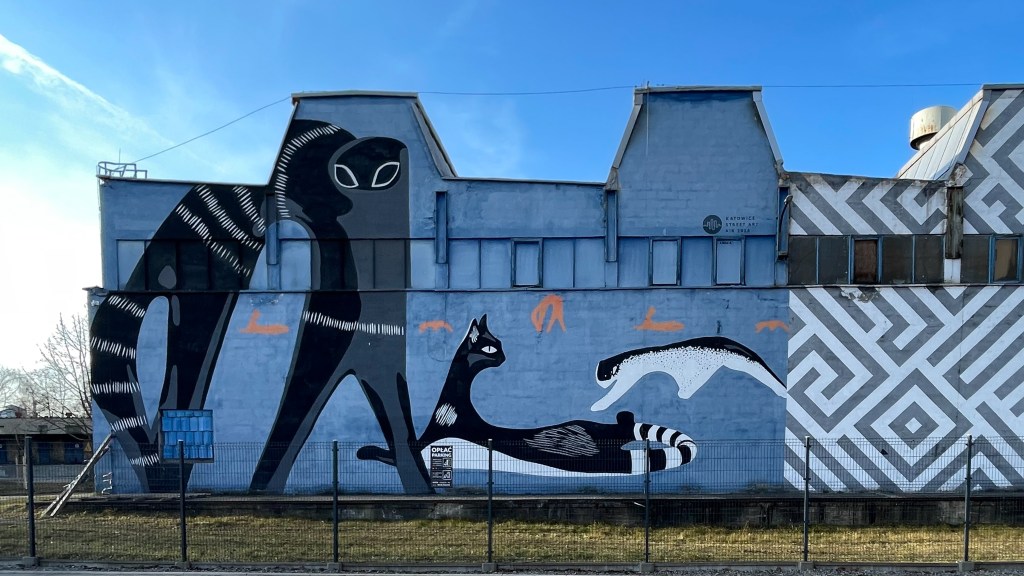
Mural by Artur Wabik, Porcelanowa 23
Street Art in Katowice: Szopienice
Going to Szopienice is a bit like leaving the city. There’s nothing surprising about that. Szopienice was incorporated into Katowice just a while ago, in the 1960s. You can feel it. Just look around you and talk to someone.
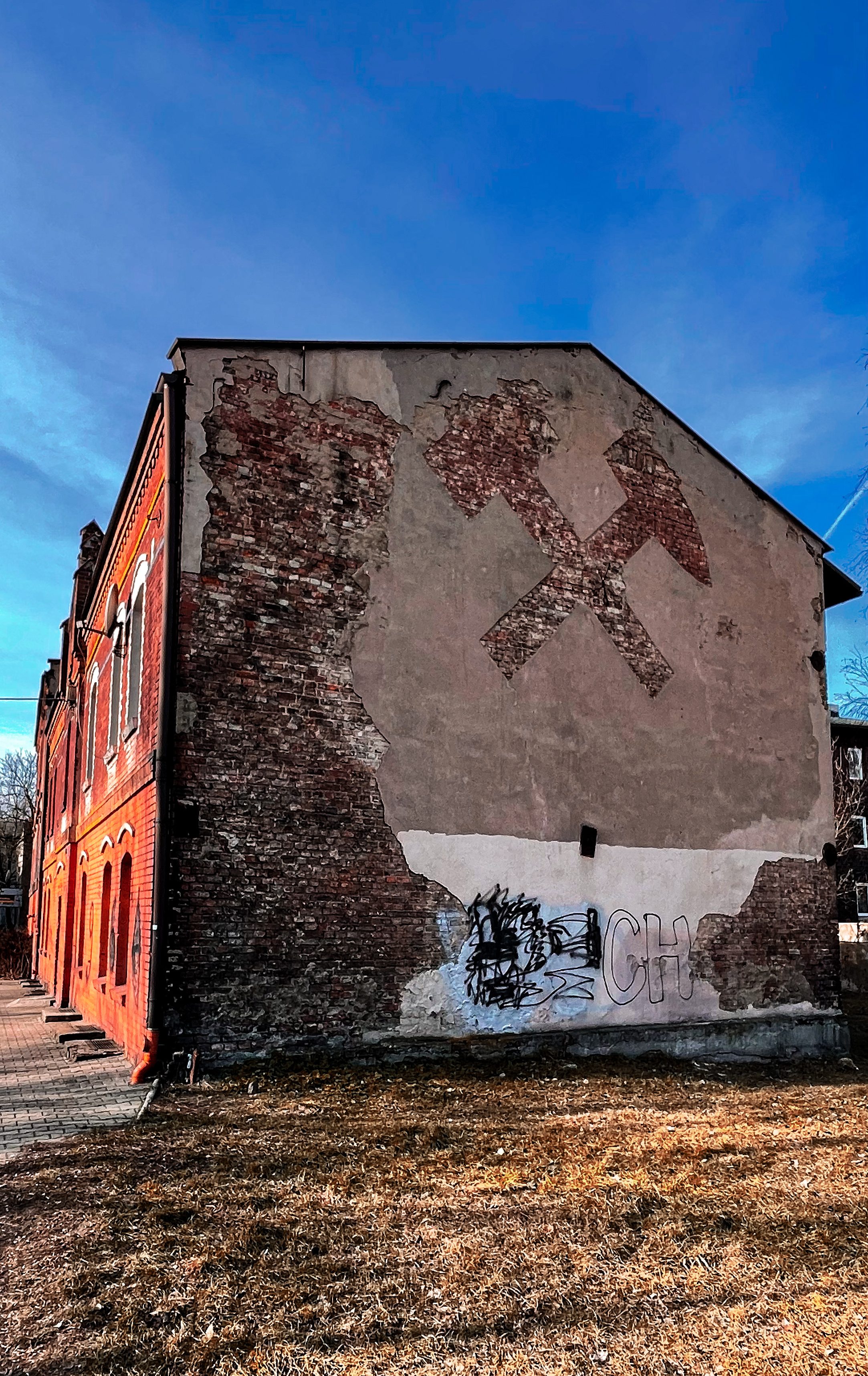
Many of the murals here are not so fresh and in pretty bad shape. However, if you have the time and have no problem with walking long distances, it is worth a look.
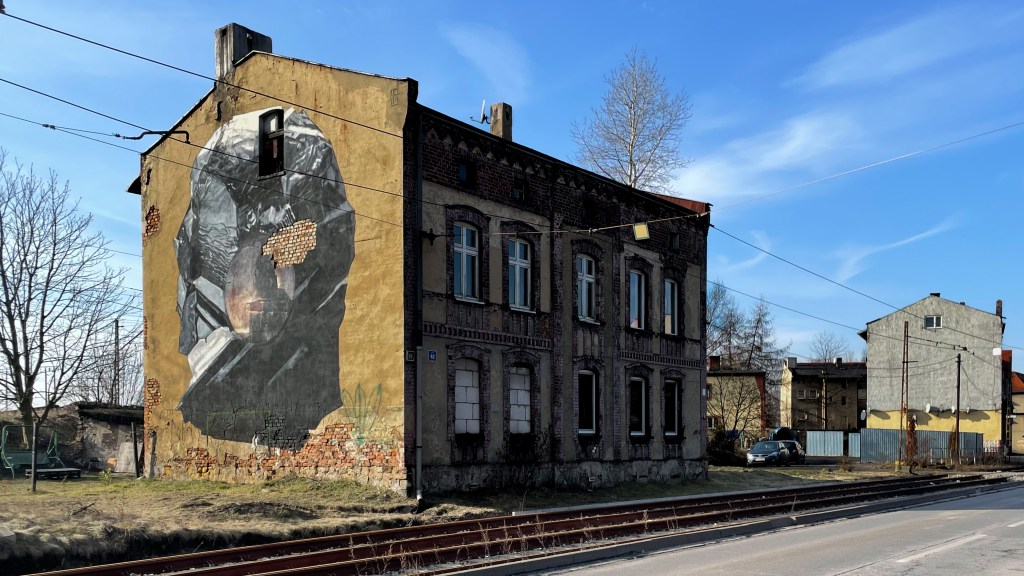
The article about Szopienice is in progress but you will find the murals already on the map.
Katowice – is it worth to visit?
Absolutely yes!
In the article above, I only described the main areas where you’ll find murals. There’s so much more in Katowice to discover! Galleries, events, coffee shops, restaurants! It’s worth looking around, peering into different nooks and crannies and discovering the most in your way that you can. 🙂
Anyway, in case you will need a little help, here a map with murals.
Murals in Katowice – the map
Sources:
I was googling a lot to prepare this article. Below you will find the sources which I used:
- https://www.wkatowicach.eu/informacje/index/Mural-przy-Galerii-Katowickiej-gotowy-Zostal-skonczony-przed-czasem-WIDEOZDJECIA/idn:990
- https://katowice.wyborcza.pl/katowice/7,35063,28429447,na-bocznej-scianie-dworca-w-katowicach-powstanie-wielki-mural.html
- https://web.archive.org/web/20180416012508/http://2014.katowicestreetartfestival.pl/festiwal/
- https://tvn24.pl/katowice/banksy-moze-zazdroscic-murale-w-katowicach-ra503055-ls3292846
- https://www.se.pl/slask/mural-na-scianie-galerii-katowickiej-przy-ul-3-maja-jest-juz-gotowy-aa-Hmd6-tZ6n-Kddu.html
- https://katowice.wyborcza.pl/katowice/7,35018,19526088,wlasny-teatr-to-ciagla-walka-o-teatrze-bez-sceny-andrzeja-dopieraly.html
- https://www.pap.pl/aktualnosci/piekny-i-imponujacy-w-katowicach-odslonieto-mural-poswiecony-zbigniewowi-wodeckiemu
- https://katowice24.info/po-10-latach-znika-kultowy-mural-z-kura-na-ul-tylnej-mariackiej/
- https://katowice.wyborcza.pl/katowice/7,35063,20983912,gole-torsy-na-scianie-powstal-nowy-mural-na-tylnej-mariackiej.html
- https://katowice.wyborcza.pl/katowice/7,35063,26968046,krystyna-bochenek-nigdy-nie-zapominala-o-najslabszych-ktorzy.html
- https://katowice.wyborcza.pl/katowice/7,35055,30525202,raspazjan-mialem-konflikt-z-nauczycielka-plastyki.html
- https://metropoliagzm.pl/2020/12/15/na-scianie-budynku-przy-ul-kordeckiego-2a-powstaje-mural/
- https://katowice.wyborcza.pl/katowice/7,35063,9910661,k-i-ch-radnym-nie-przeszkadzaja-sztuka-tak.html
- http://sztukaprowincjonalna.blogspot.com/2011/05/sepe-i-chazme.html?m=1
- https://miasto-ogrodow.eu/strona/mural_bezpieczne_miejsce/mid/620
- https://katowice.wyborcza.pl/katowice/7,35063,18180057,mural-z-gornikami-robi-furore-a-autorka-komentuje-tata-sie.html
- https://streetartnews.net/2013/04/mobstr-new-mural-in-katowice-poland.html
- https://www.widewalls.ch/magazine/katowice-street-art-festival-2015/city-in-crisis
 Part of Streets

What an excellent blog. Great and really thorough read with some amazing murals
LikeLiked by 1 person
Appreciate it! I do my best. 🙂
LikeLiked by 1 person