
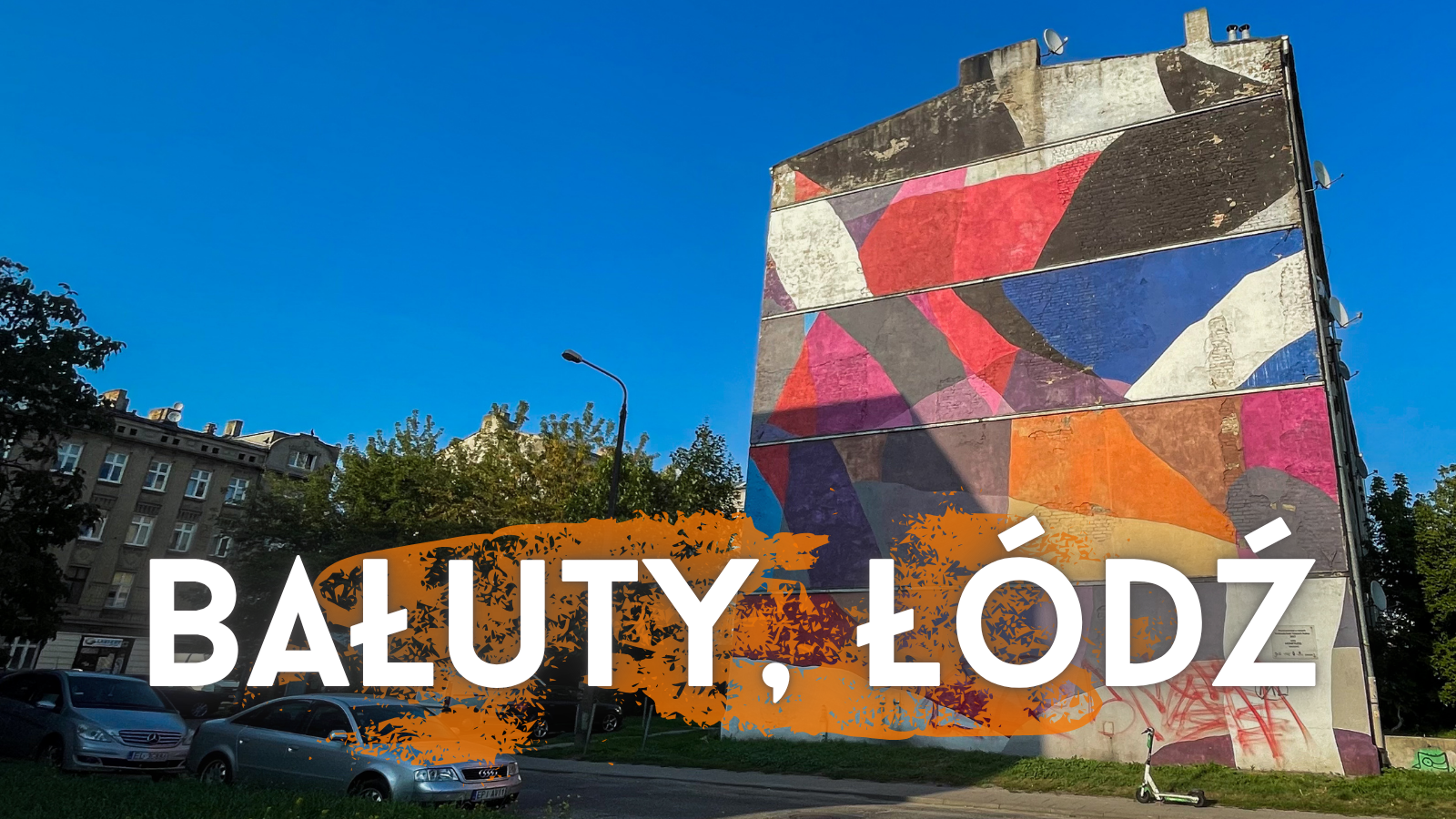
Baluty is one of the most interesting districts in Lodz. Anyone who lives in Lodz, has their own opinion about this place. Not necessary a positive opinion. Being here you can have many different feelings, from fear to fascination. You don’t even have to make a special effort to know this neighbourhood off the beaten track. Almost everything here is exceptional. So, let me show you around and explain some things. 😉
Table of contents
- History of Baluty in a nutshell
- Street Art in Lodz: Baluty
- Urban Art in the Survivors’ Park
- Baluty and Street Art – what else?
- What is the best way to get to know Bałuty?
History of Baluty in a nutshell
The uniqueness of Bałuty begins with the beginning of the city of Lodz. Originally, Łódź and Bałuty developed as independent territories. Lodz was a city where factories were built, and Bałuty was a dormitory for workers from Lodz’s factories. Bałuty was independent to the point that it became the most populated village in Europe. Finally, during the First World War Baluty adjoined to Lodz.
The fact that Bałuty developed not as an official part of Łódź had a powerful influence on the district’s appearance today. There was no zoning plan for Bałuty, which cannot be said of the Lodz area (until a certain point, of course). That is why today we can observe such an irregular „mess” of streets and buildings in Bałuty.
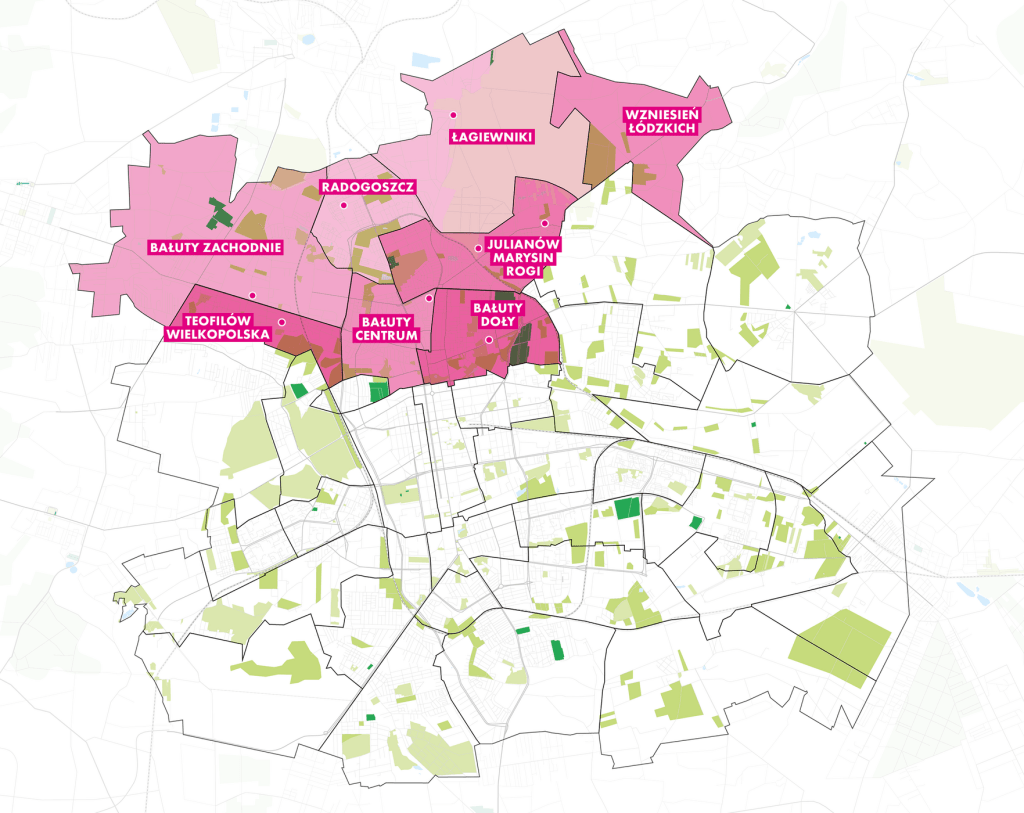
Baluty is a unique place. If you want to deep dive into not-obvious Lodz and walk off the beaten track, you are at the right place. In this article, I will tell you more about the art around here, but this place has a lot more to offer, from an interesting and not easy history to a local market and a special community.
Street Art in Lodz: Baluty
It would be shameful for a place with such history like Baluty to have nothing painted on the walls. 😉 What specifically can be found in Bałuty? I will tell the story below:
- Baluty – writings on the walls
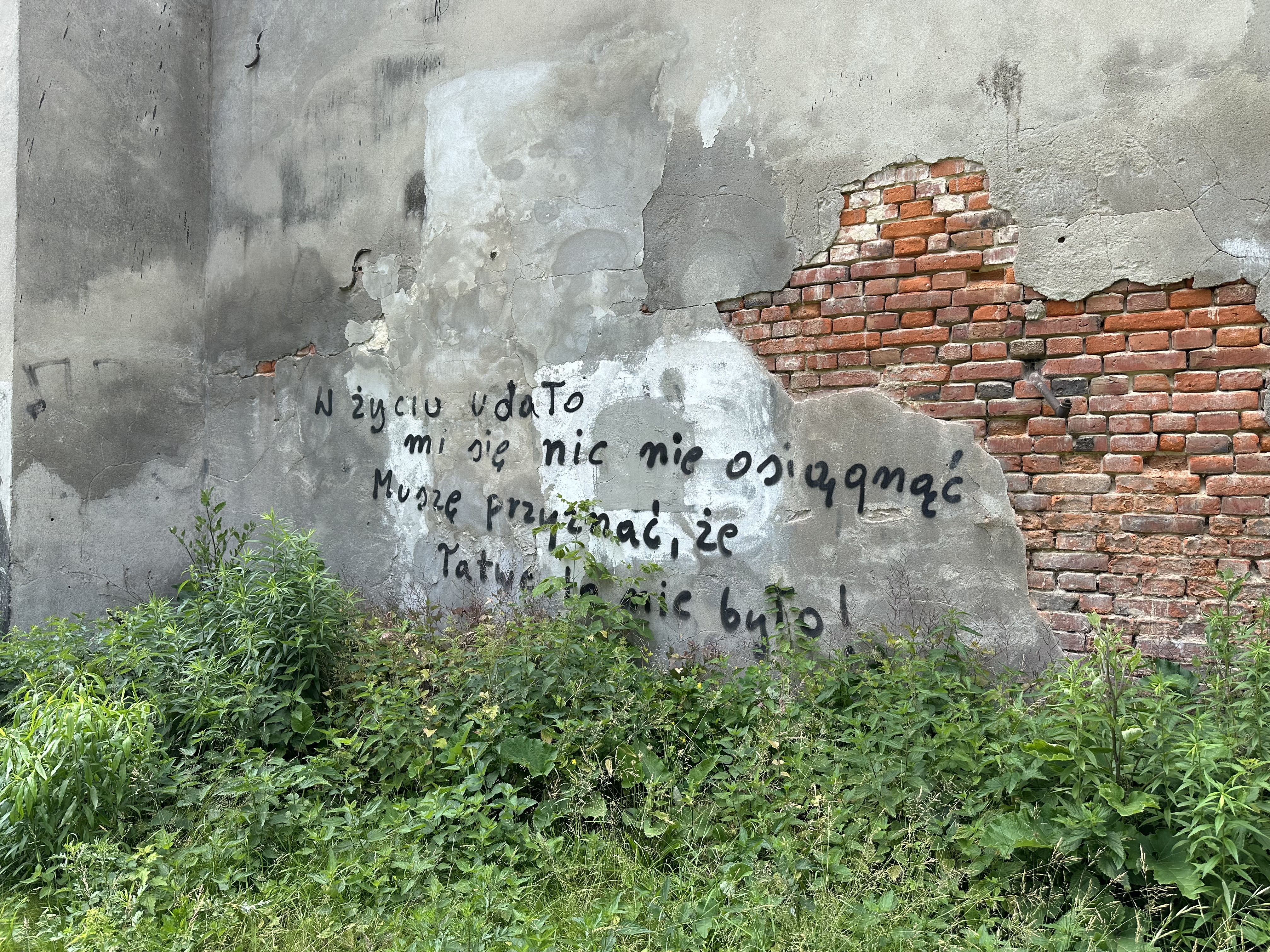
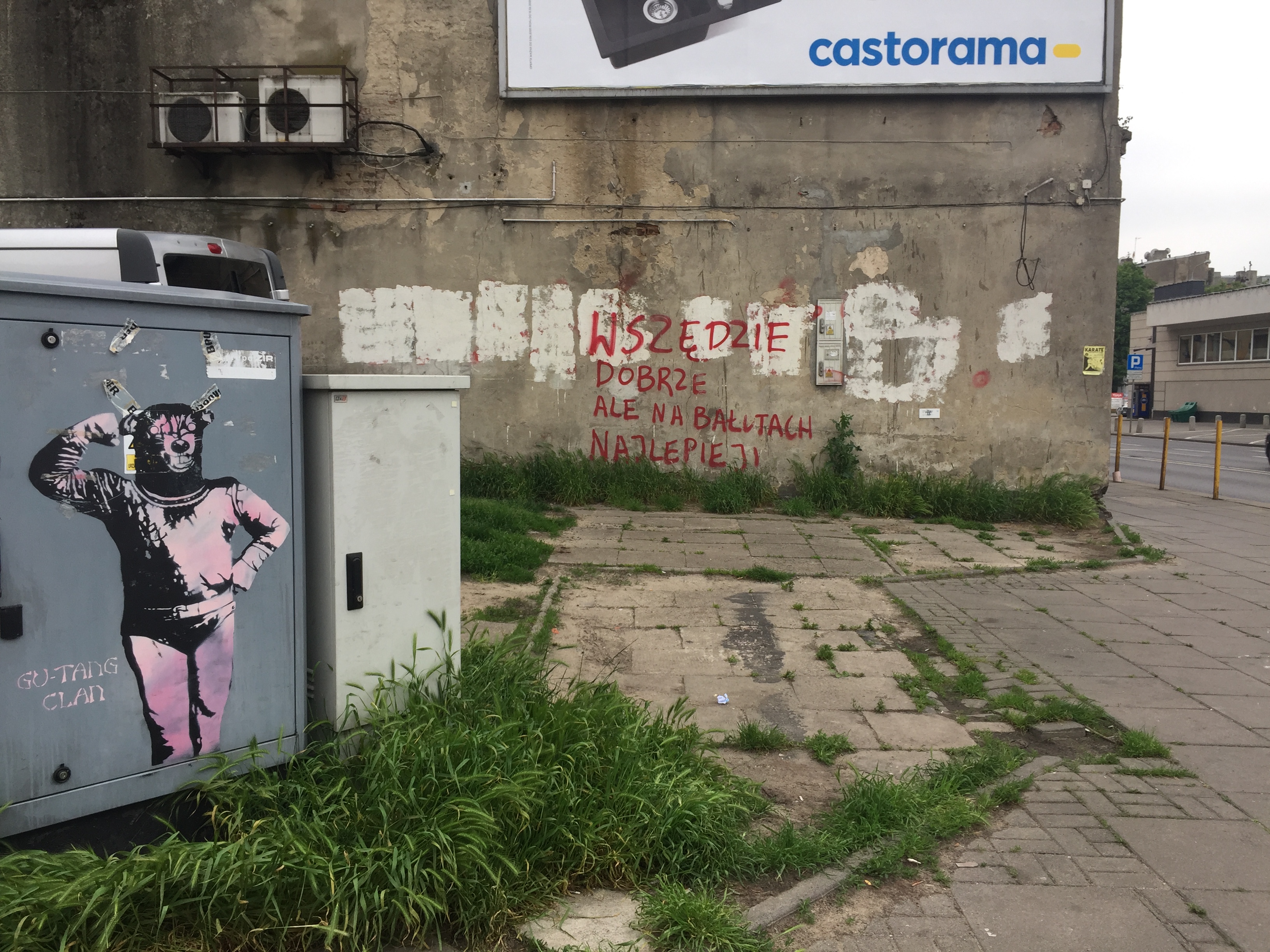
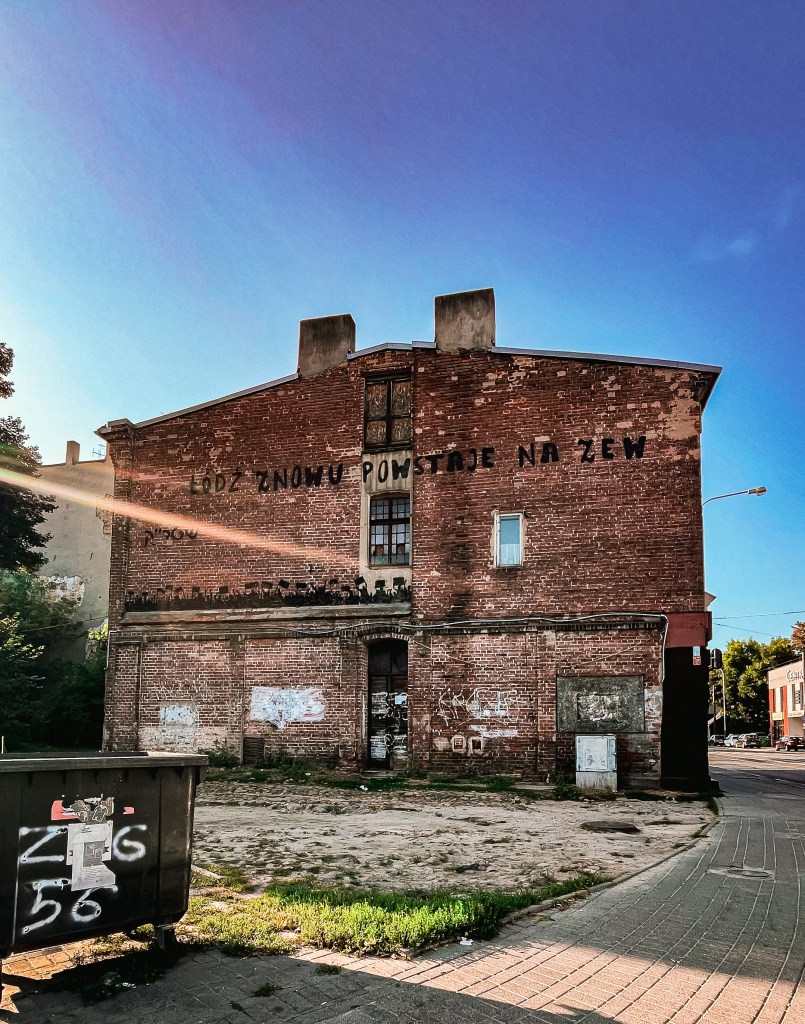
In Bałuty you can find many inscriptions on the walls, often referring to the surroundings. The important thing – the inscriptions are in Polish! So either you take an interpreter with you (here I am) or you would have to hurry up and learn some Polish. We all know that Polish is very easy and pleasant, don’t we? 😉
Most of the writings here are made by Baluty Pany i Panie (Kacper Zaorski) who observes and describes this neighbourhood .


Bałuty: murals
There are about 20 quite big murals on Baluty. You can find a list of them below.
Bomber by INO, Marynarska 54
One of the biggest and original mural’s in Lodz. Painted by artist from Greece, known as INO. His real identity is a secret. In his pictures you will see black and white figures with a single blue element, such as a spot of paint or a brush stroke. The mural in Lodz shows the ancient man who holds a bomb. The work was coordinated by the Urban Forms Foundation.

The mural by Mik Shida, Wojska Polskiego 84
Another mural is the work of a Polish-Australian artist. Shida describes his style as “expressive, psychedelic and based on fractals.” In his work you will find monstrous figures inspired by science fiction and fantasy films. Besides the mural you will find here the Romani Forge, which remains under the care of the Museum of Independence Traditions. The Romani Forge is one of the surviving buildings of the former Gypsy camp, which existed during World War II. Inside the building is an exhibition on the extermination of the Roma and the history of the camp.

The mural by Otecki, Rybna 2/4
This mural surprised me. It appeared completely unexpected. As I read later, it was the reason for that. The author of the mural – Otecki, i.e. Wojciech Kolacz – when creating his works, selects colors to match the facade and the surroundings. As a result, it fits perfectly into the urban fabric. Works of Otecki are full of references to local folklore and legends, as well as events characteristic of a particular place. His works can resemble cubism in their form. I can see it in this mural, how about you?

The Thank You. Lost Giants Project. Stormie Mills, Młynarska 2
Stormie Mills is a street artist from Wales. A characteristic feature of his work is his monochromatic colour palette. He has created works as part of his “Lost Giants” series in Perth, Melbourne, New York, Miami, Tokyo and London.
The mural was produced as part of the Lodz “Energy of the City” Festival, whose theme in 2016 was urban cycles: building, destroying, demolishing, rebuilding. The organisers, the Urban Forms Foundation, located the festival activities in places important to the local revitalization process.
Now we have 2024, so 8 years passed. It makes me wonder if this area was really that important? Here we are, and not much has changed here.
Mlynarska Street was substantial in the past. This is where the heart of Baluty used to beat. It is hard to believe, but before the war, there were three cinemas, a movie theatre and a Jewish cafe. Keep our fingers crossed that the face of the street will change in the future.
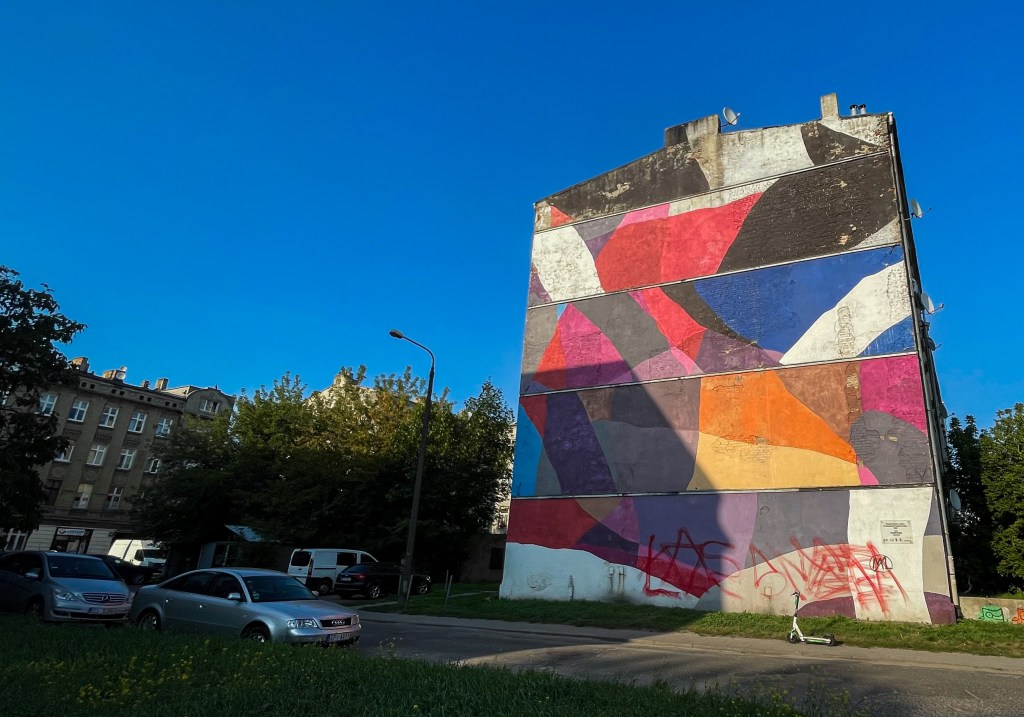
A mural by Moneyless, Wojska Polskiego 3
Teo Pirisi aka Moneyless is an Italian artist. The name Moneyless reflects on his approach to art. He always tries to create his art and keeps the budget low. His abstract, geometric works are full of dynamism but still minimalistic. Even we are talking about the huge wall, like in the case of Lodz. His mural fits here perfectly. It stands alone in the background of grey and brown buildings.
Moneyless created the work as part of the Lodz of Four Cultures Festival (now known as The Łódź of Many Cultures Festival).
Remanufacture / Herring. A tribute to Władysław Strzemiński. Opiemme, Bojowników Getta Warszawskiego 3
“Poet of the street art”, I mean Opiemme, created three artworks in Lodz. One of them is at the school building which was built after the II World War on the former ghetto grounds. The school looks exceptional. It has tall vertical windows, a pedestal, a cornice and a wide portico with columns. Opiemme made use of the existing architectural elements.
It is Opiemme’s Tribute to Wladyslaw Strzemiński, the Polish vanguard abstract painter and typographer who designed this unique font in the 1930s. Mostly consisting of a curved line, the font Opiemme drew on was actually meant to communicate the spirit of future, dynamism and modernity across Polish society. The artist uses this type of lettering as an insight into the socialist realism architecture, the urban style of many public buildings that still speak about Poland’s heritage, regardless of the cultures that have cast the country throughout the time.
from critical essay by Claudio Cravero

The interesting thing is that the same technique is also employed in Opiemme’s Herring, a mural on another school wall. Herring is connected with the unofficial name of the park which is nearby. This park is called the Park of Herring because of the fish market which was here before the war. Unfortunately, the war changed everything but there is a legend that you can still smell herrings here if you close your eyes. 😉

What’s more – the alphabet created by Władysław Strzemiński and applied by Opiemme was also used for creating the logo of the city of Łódź. This logo looks cool, don’t you think?
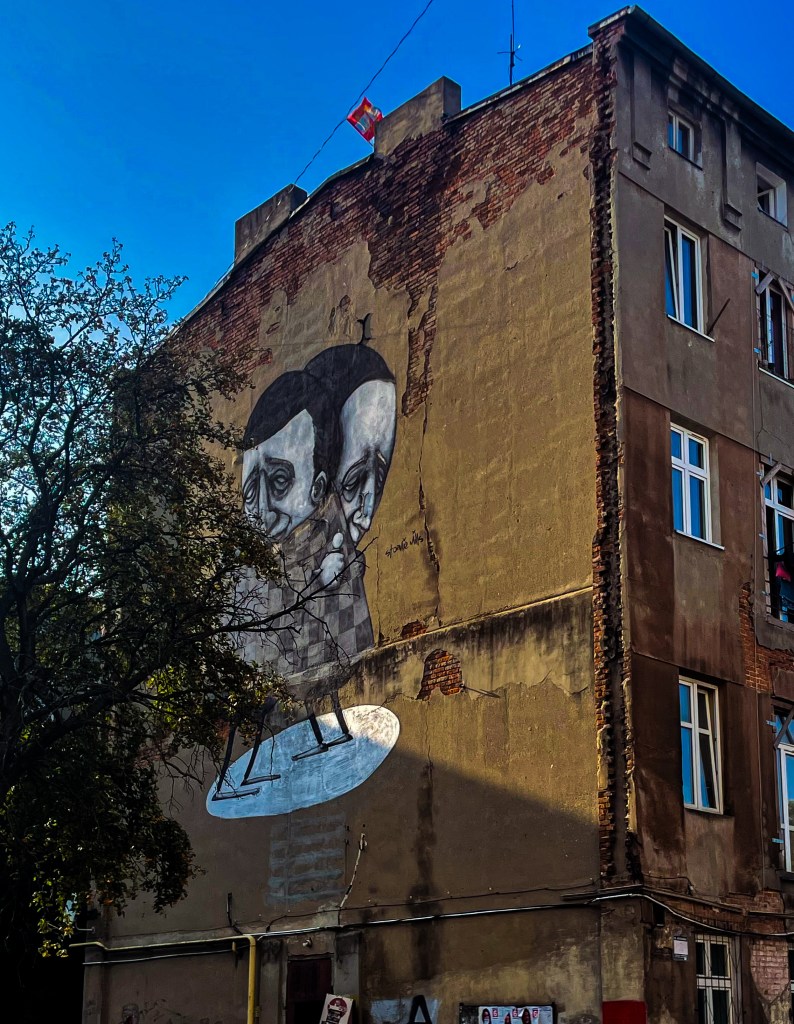
Maciej Walczak, Pawel Ponichtera, Wojska Polskiego 182
About this mural I found out quite late. Shame on me. But the time to catch up came finally! The mural is called “The Mirror”. Pawel Ponichtera came up with idea, and painted it in collaboration with Maciej Walczak (who was a curator of great exhibition Rejwach. I wrote about it here). The central, white-black part is painted by Maciej, and credits for the gold frights go to Paweł. So, what is the meaning of this mural? No one explain you this better than the author himself:
The round Mirror inside the mural symbolizes a reflection of the individuals childlike aspect, where the child inside has a halo of innocence around its head. The child is woven between different and mysterious aspects of our psyche, like animalistic figures or adult/manly like unpleasant faces. The two yellow figures symbolize the unknown, uncontrolable and spontaneous forces, which allow us to finally see inside ourselves.
You can read the whole statement here.

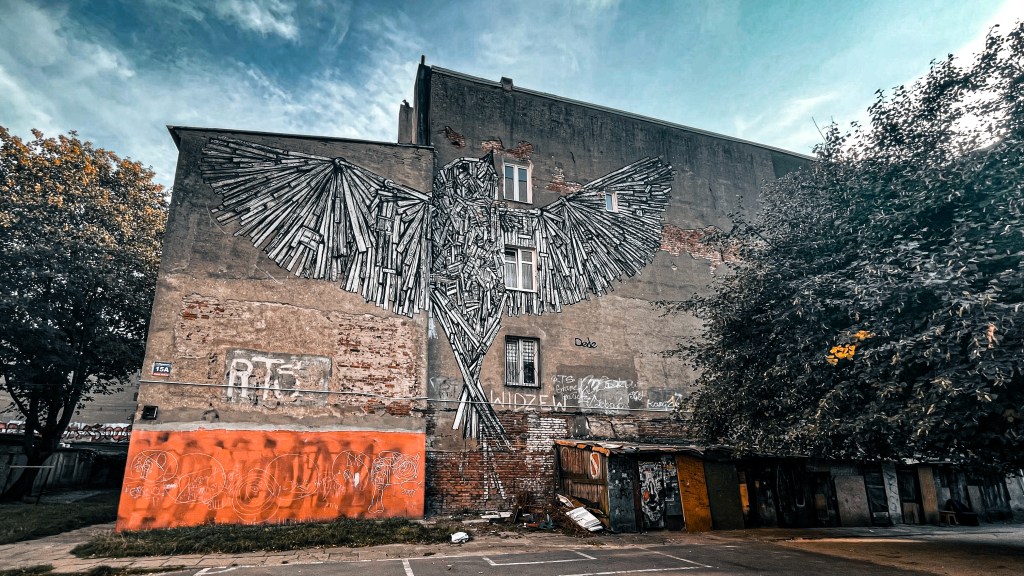
Dede: Searching Safety II Organizacji WiN 10 & Searching Safety Młynarska 15
Dede – an artist from Israel, created two murals in Lodz. The first one is built entirely of band-aids, which symbolise the different kinds of difficulties and overcoming them.
“I was seeking a way to express and heal my wounds. The band aid then became a symbol for all kinds of difficulties – personal and social — seeking fix.” // Dede

The second mural is on Mlynarska Street, which I have written about above. This mural is no longer made of band-aids but of the old boards. The mural is part of the Wooden Animals series.
Nitzan Mintz, WiN 10
Related to Dede is Nitzan Mintz, who also had the opportunity to create some art in the Bałuty. Dede and Nitzan Mintz often collaborate on artistic realizations. Their artistic careers began with their mandatory military service in Israel. However, they didn’t work together in Lodz but you can find their works very close to each other.
Nitzan Mintz wrote a bilingual poem on the walls of a building in Bałuty, based on the history of Bałuty and the ghetto created here. The Polish version of the poem was placed on the wall of the cells on the side of Pasterska Street. The Hebrew version is on the door of the cells on the side of the courtyard.

Piotr Chrzanowski & Alan Osiecki, Organizacji WiN 10
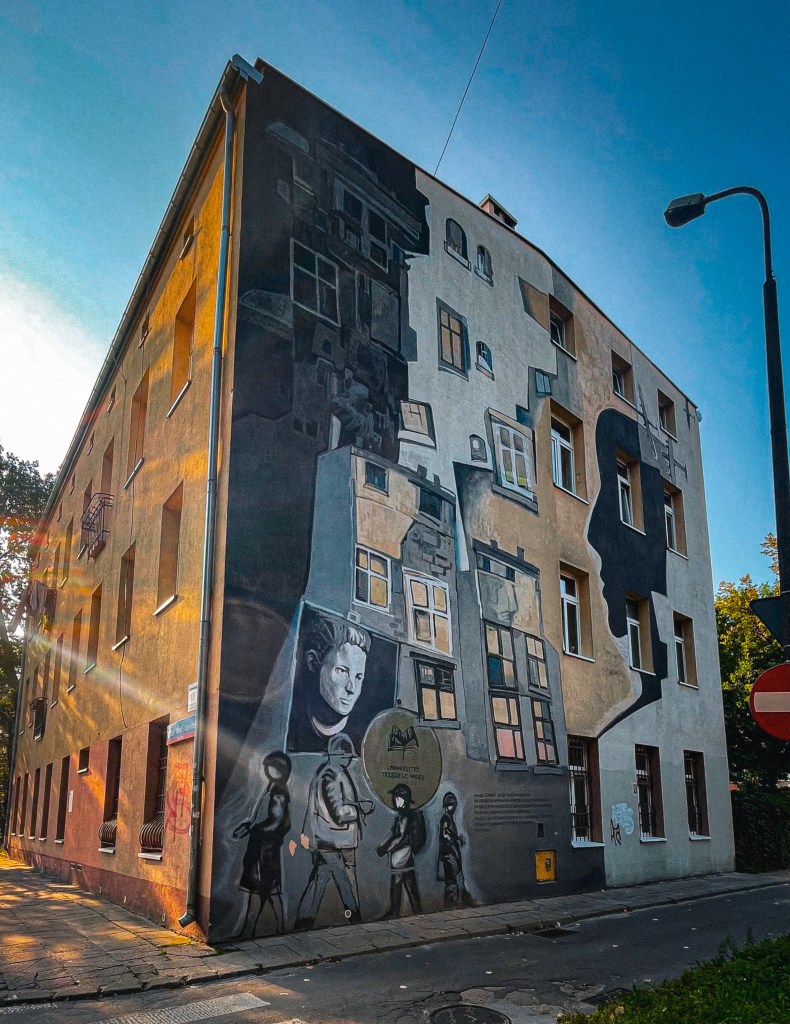
This mural was created to commemorate Halina Szwarc-Kłąb, a Home Army agent during World War II who used to live in the building. The project was made at the initiative of the local community. Interestingly – during the renovation of the tenement, a suitcase with mementoes of ghetto inmates, which was located here during the war, was discovered in the attic.
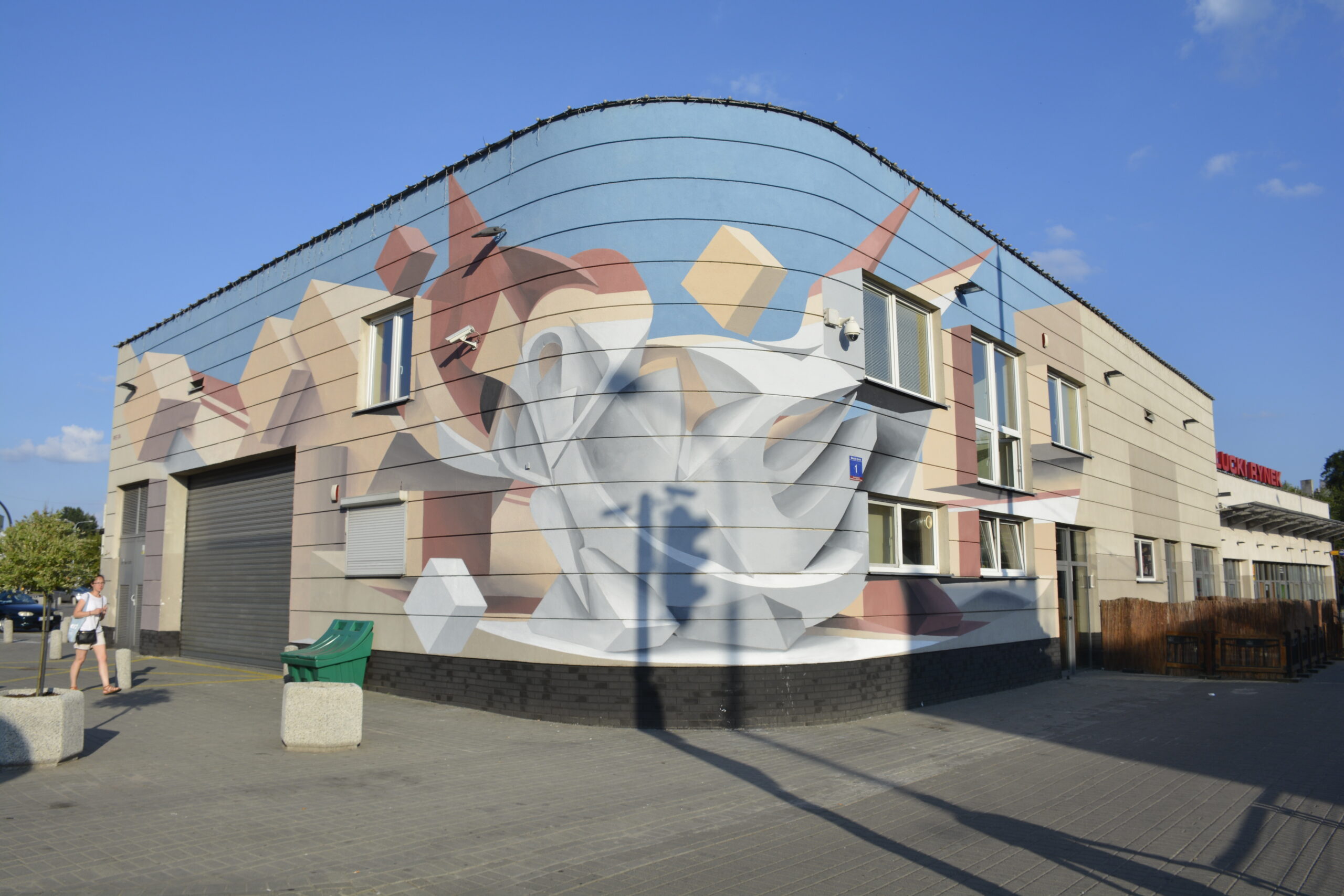
PEETA, Rynek Bałucki 1
It will be better if you decide to see this mural in the afternoons. It is located in the Balucki market so in the morning there are a lot of stalls, and even more people. If you want to get fresh vegetables at a good price, pickles, cigarettes or slippers, come here bravely. But for taking pictures of the mural it’s better to visit this place in the afternoon.
Peeta is the pseudonym of Italian-born artist Manuel Di Rita. His art is inspired by the lettering characteristic of classical graffiti, as can be seen in his work at Rynek Bałucki. At first, Peeta only painted his nickname in graffiti style, but over time he began to add geometric shapes to the letters. His works merge with the wall and match the architecture, giving the impression that the shape of the building is completely different from reality.
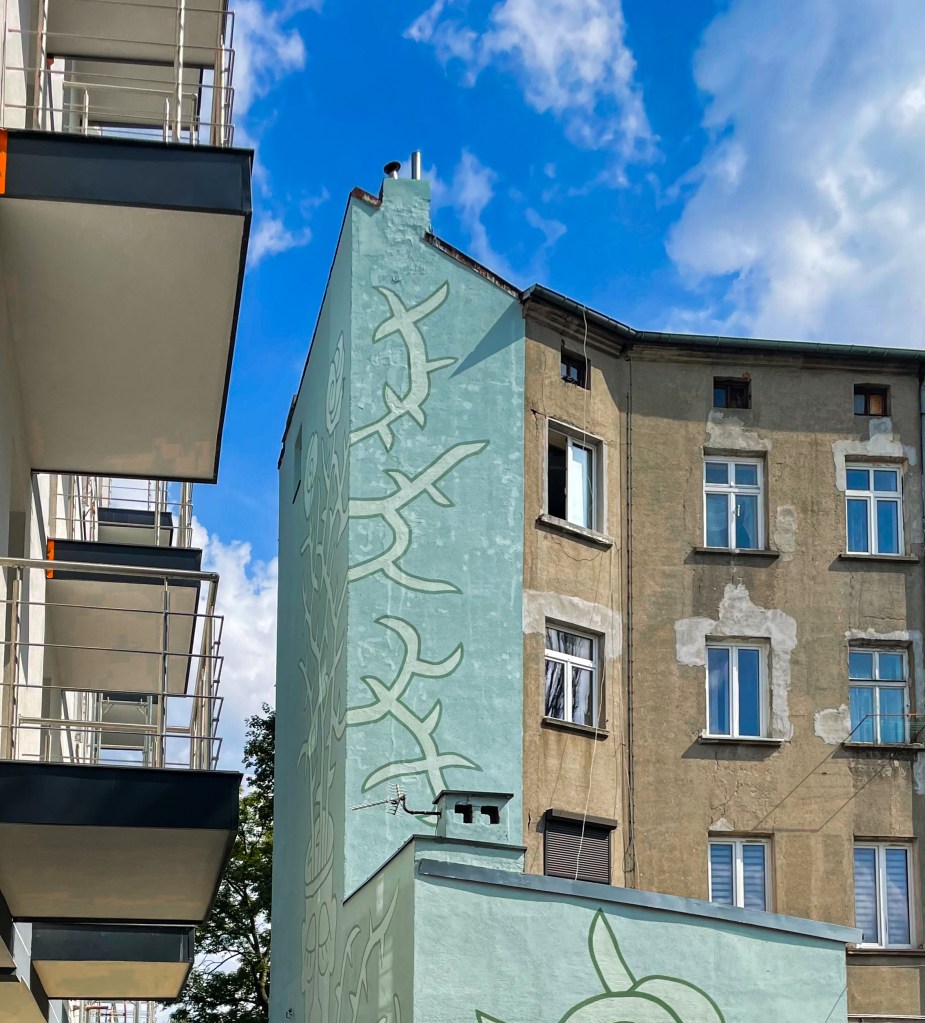
Maciej Walczak, Sierakowskiego 19
Another mural, one of the recently created in Bałuty, is the work of Maciej Walczak. The mural consists of his characteristics and the patterns are in an eye-pleasing green. Interestingly – the mural was created using anti-smog paints. My photos of this work are not perfect, as the renovation is not completed yet, and it wasn’t easy to find a good photo spot.
Magda Ćwik, Dzieci i ryby glos mają (Kids and fish have voice), Warecka 1
It’s unlikely that you come across this mural by chance. It is located far away from the center near the expressway. I came across it while driving with my cats to the vet.
The mural is strongly associated with environmental issues. It was even unveiled on the day of the Strike for the Earth. The author of the work, Magda Ćwik, is a person of great ecological awareness. The mural itself hides many symbols referring to both the city and ecology. What’s more, part of the mural is painted with a special paint that glows in the dark to emphasize the advantages of using solar energy. The Urban Forms Foundation was involved in the creation of the mural.

CARNE, ul. Łanowa 14
CARNE (the artist from Italy) painted two murals in Lodz. One on the wall of the Balucki Cultural Center, another in Śródmieście.
Smoke by TOPE, Cedry 3a
I had to walk a long distance to see TOPE’s mural of an ex-office of Urban Forms Foundation. But it was worth it. The mural was a prelude to series of paintings under the title “SWEET&SOUR” which is meant to take viewers on a psychedelic journey through other dimensions.

Other murals I’ve come across in the Bałuty:
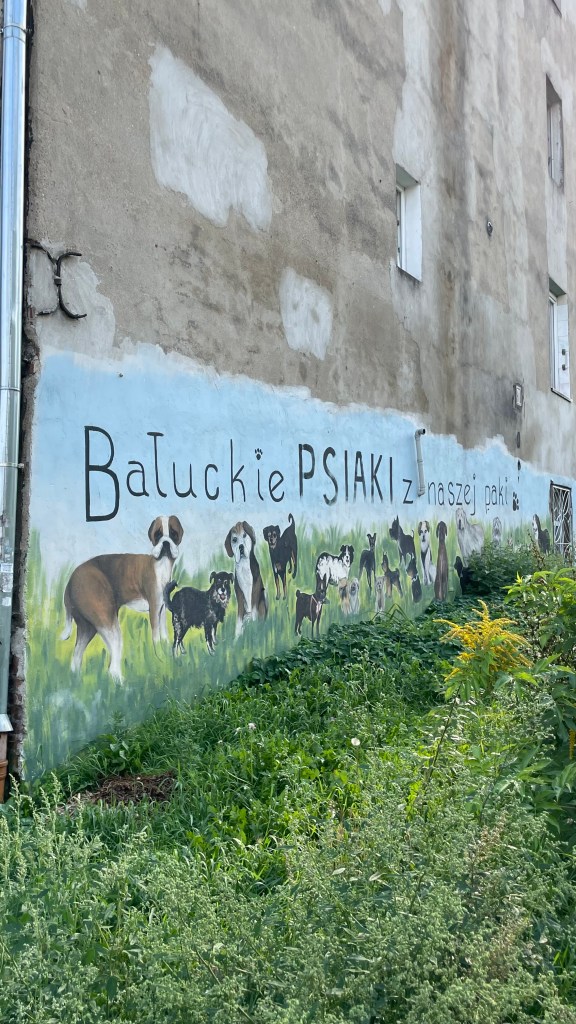
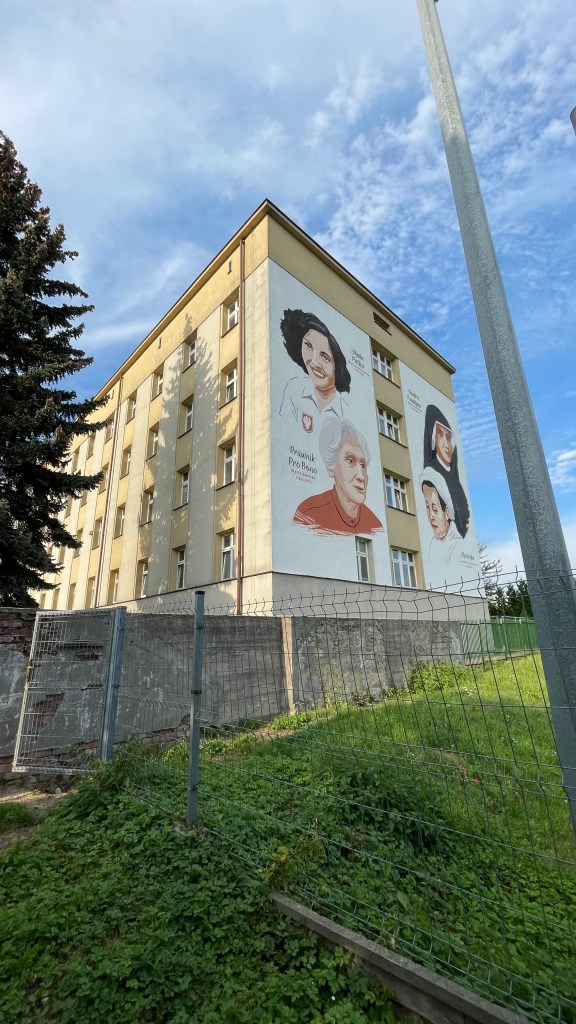
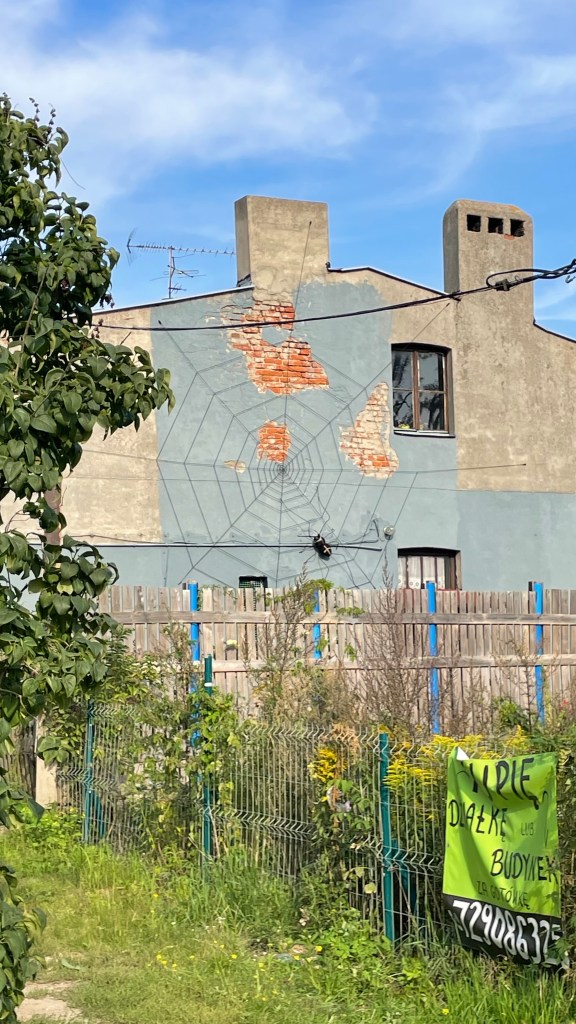
Urban Art in the Survivors’ Park
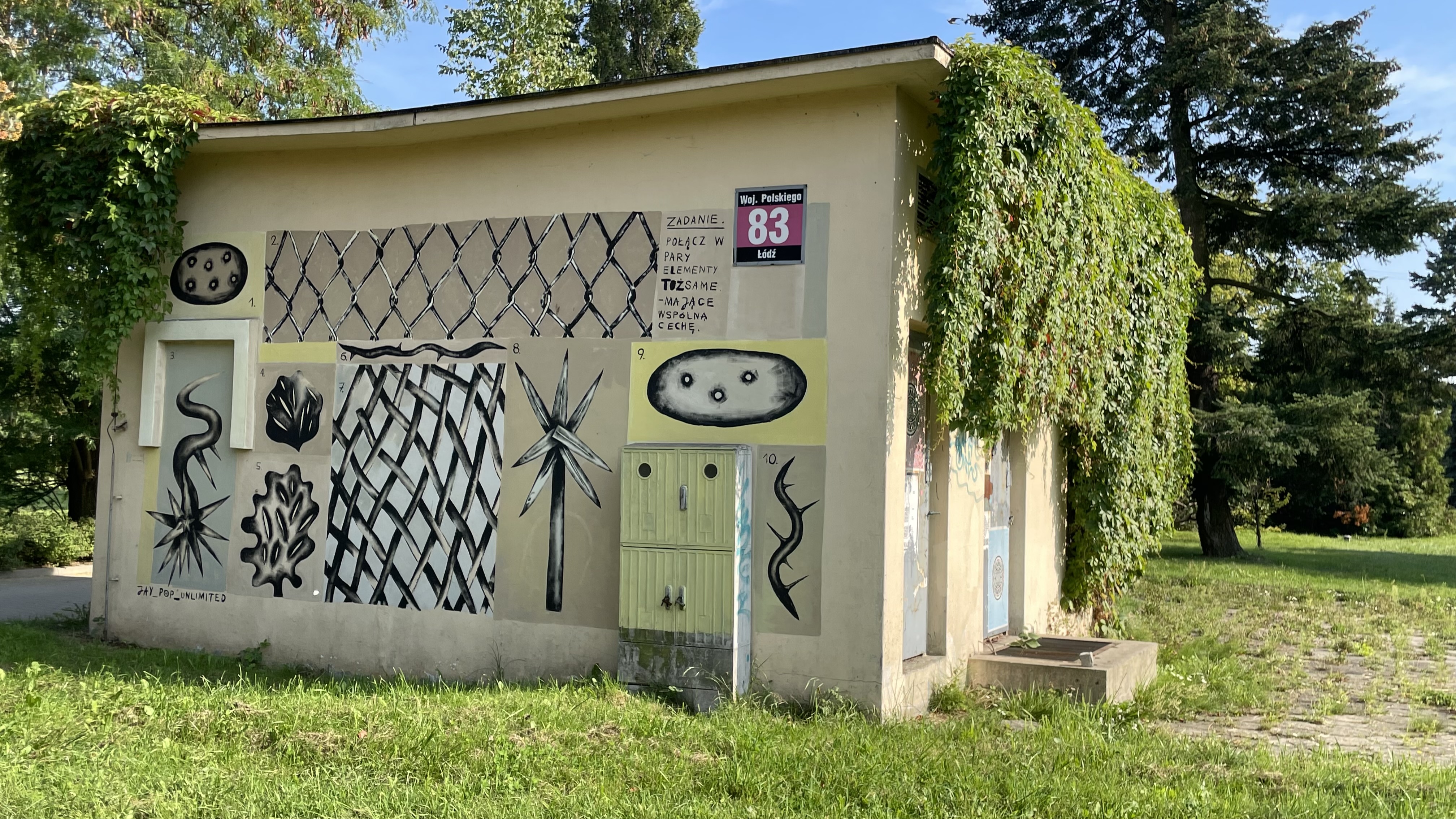
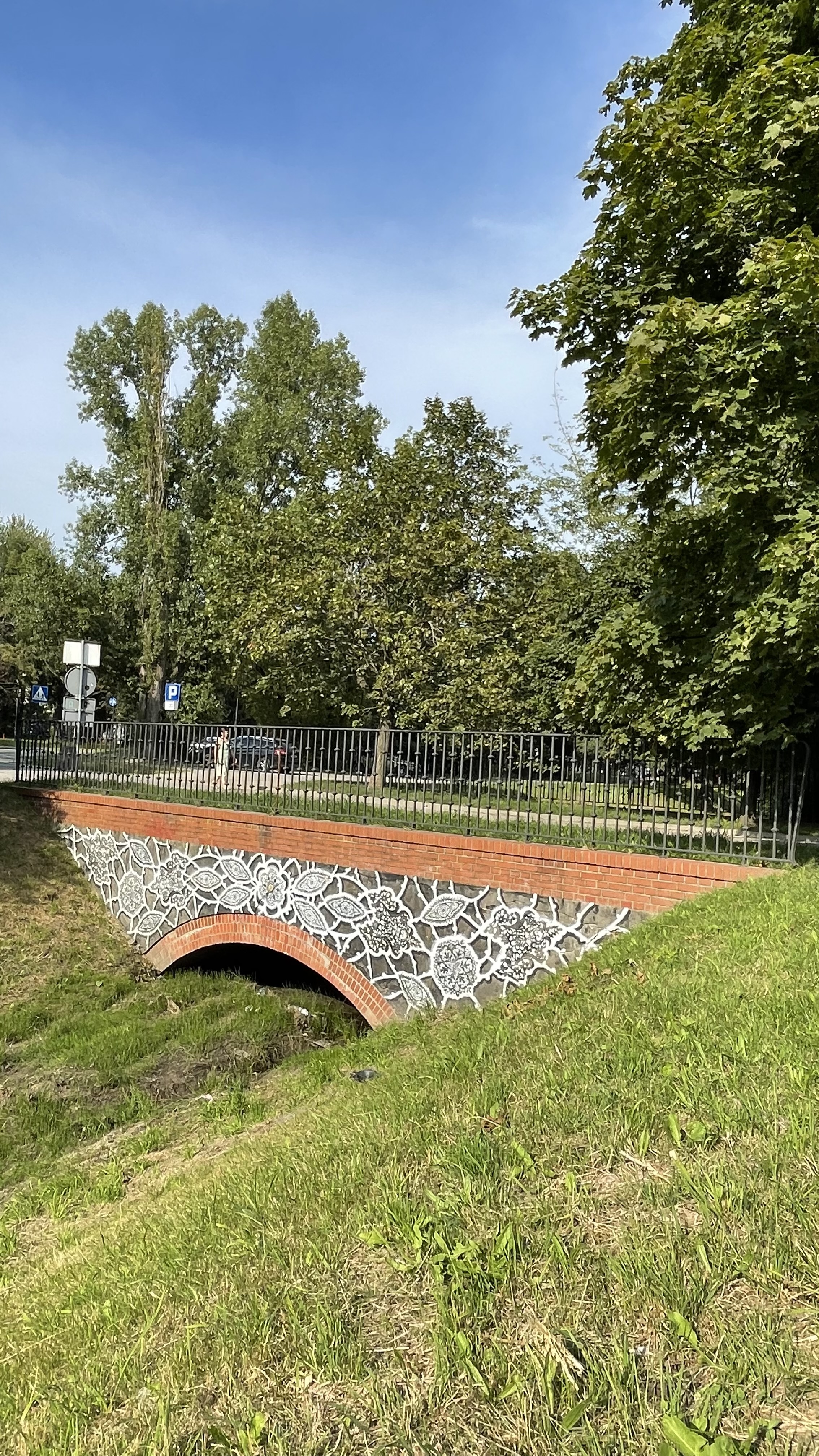
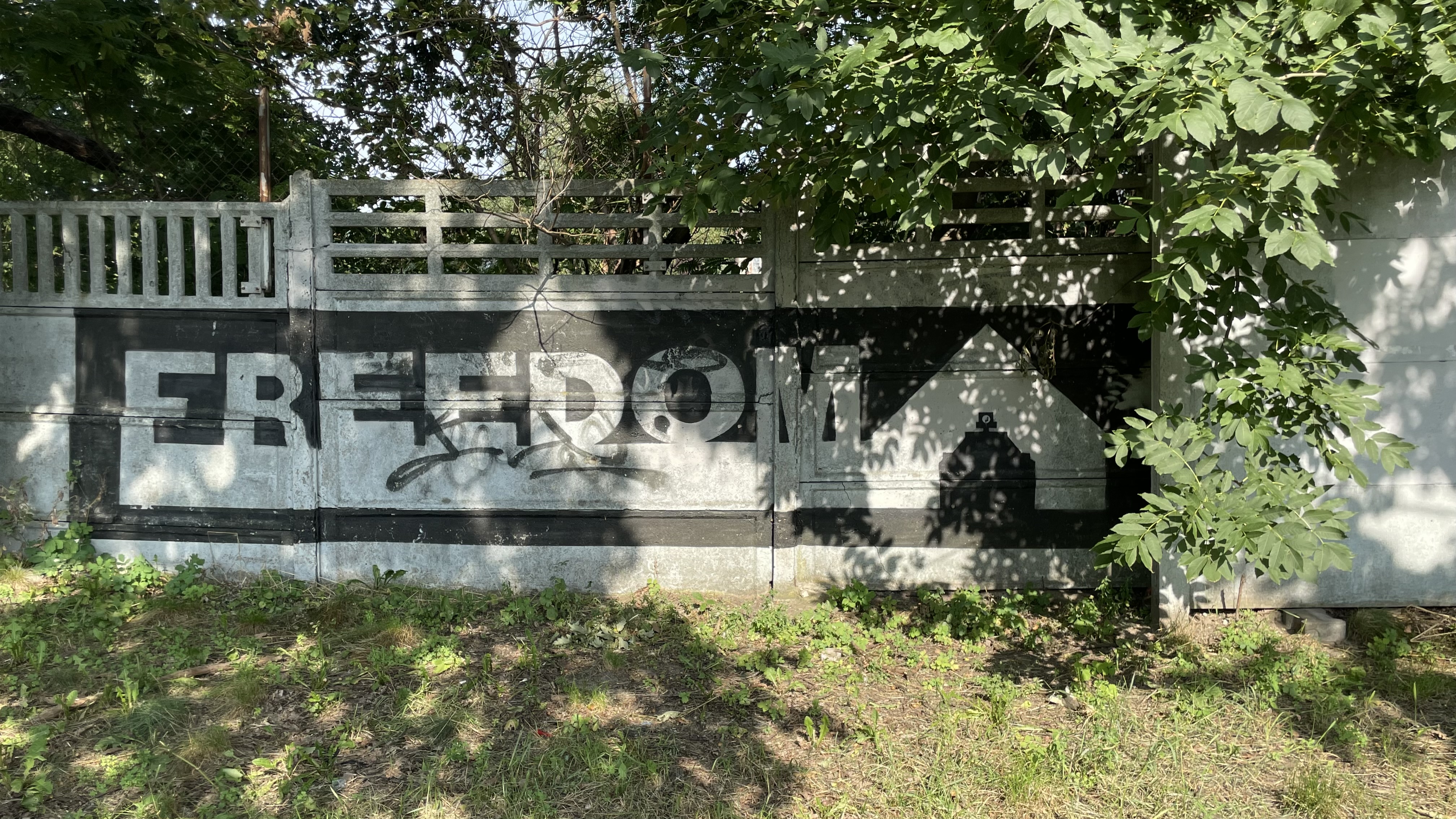
Are these all the murals in Bałuty? Well, not exactly. You’ll find a few more in the Survivors Park, which appeared quite recently, in 2023, almost all of them were created as part of the Lodz Four Cultures Festival. The idea of this event refers to the time when Poles, Jews, Germans and Russians created the greatness of industrial Lodz. The festival takes place in mid-September each year.




Baluty and Street Art – what else?
Children of Bałuty – memory murals
In Bałuty, besides the above-mentioned stuff, you will find some untypical examples of art. One of them is “Children of Bałuty – memory murals”, which refer to the history of children from the Lodz Ghetto. These are authentic images of Polish, Jewish and Roma children reproduced from archival photographs.


Children of Bałuty – map

ŁÓDZKI/LUDZKI KOT (LODZ/HUMAN CAT)
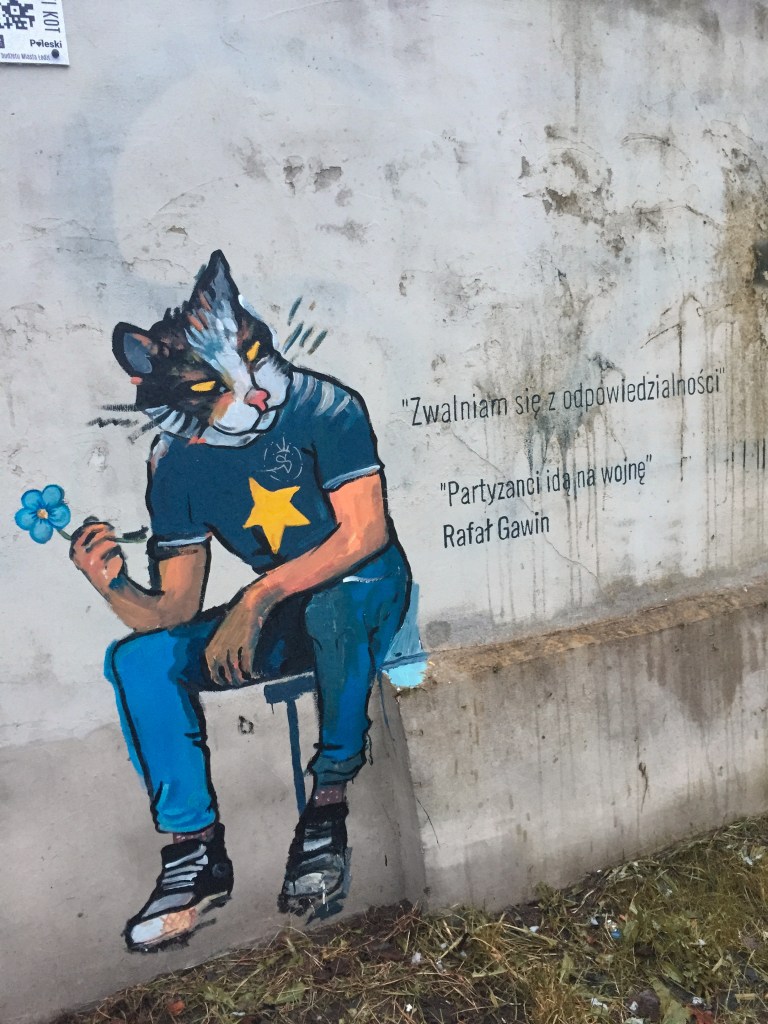
In Bałuty you will also find one of five Lodz cats to promote the work of local poets. Piotr Chrzanowski and Natalia Biegalska are the authors of this project. Their cats are a variation of the theme of a modern, adult Filemon – a character from one of the fairy tales produced in Lodz.
Anka Leśniak Art Installations
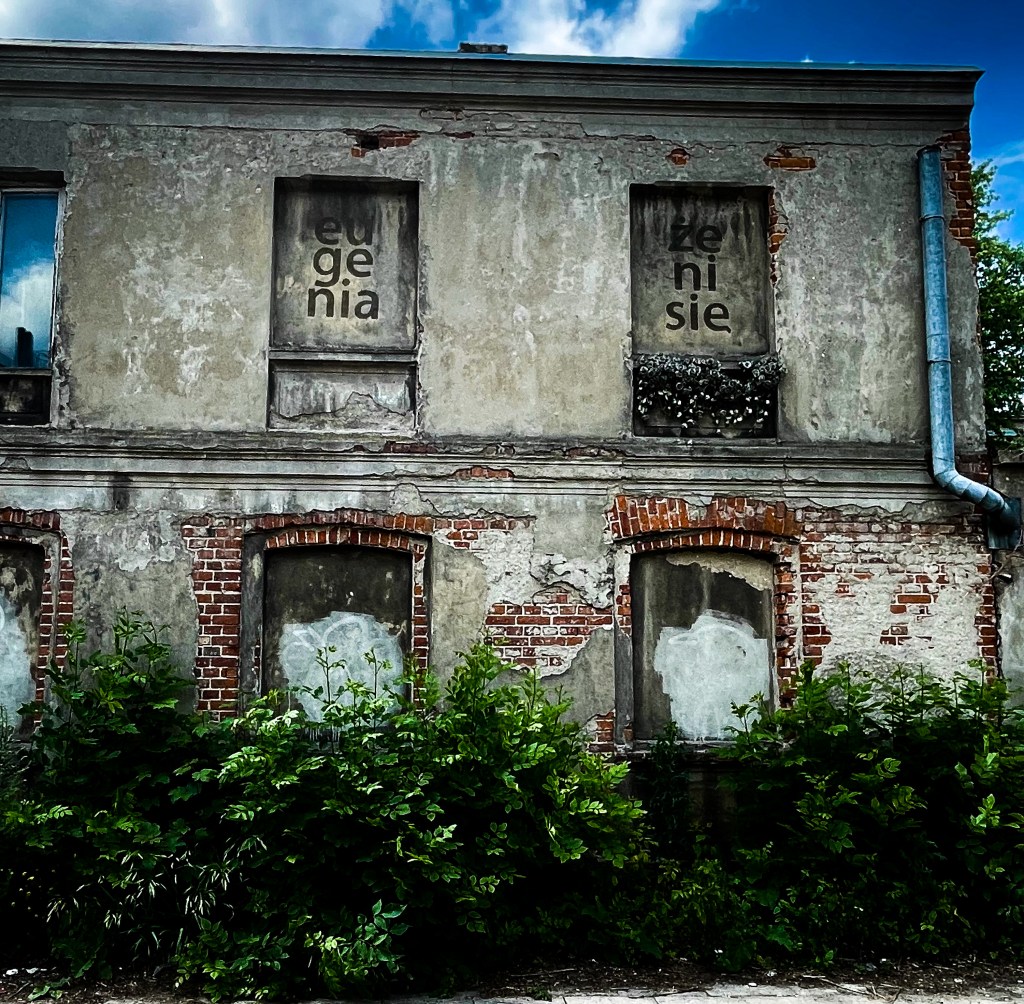
The artist’s first installation from 2015 here is the project Eugenia się żeni (Eugenia gets married). While the work itself may not impress, the story of Eugenia herself is quite original. Eugenia lived in Baluty before the war. Those were times when women had far fewer opportunities than today. Therefore, Eugenia pretended to be a man to get a better-paying job. As a result, Eugenia had trouble with the law and her personal life. Well, Eugenia got married as a man. The fraud was discovered, not by Eugenia’s spouse, but by the police.
The title of the installation is a game with the Polish language. The form “żeni się” is grammatically incorrect to refer to a woman whom is getting married. However, it is sometimes used in colloquial speech. And besides, the word “żeni” also refers to the diminutive of the name Eugenia – “Żenia”.
The second work, at Zgierska 56th, was created in honour of Zula Pacanowska – the leader of the resistance movement in the Lodz ghetto, a pre-war communist knitter, and an actress. The font used in the installation was based on slogans from placards from contemporary women’s strikes. In the work, you will also find quotes from “Piesn o Lodzi”, the inscription “STRAJK” in Yiddish, the dates of her birth and death, and the order that Zula Pacanowska received posthumously, with the male figure changed into a female one.
The work was created as part of the celebration of the 80th anniversary of the liquidation of the Lodz Ghetto.

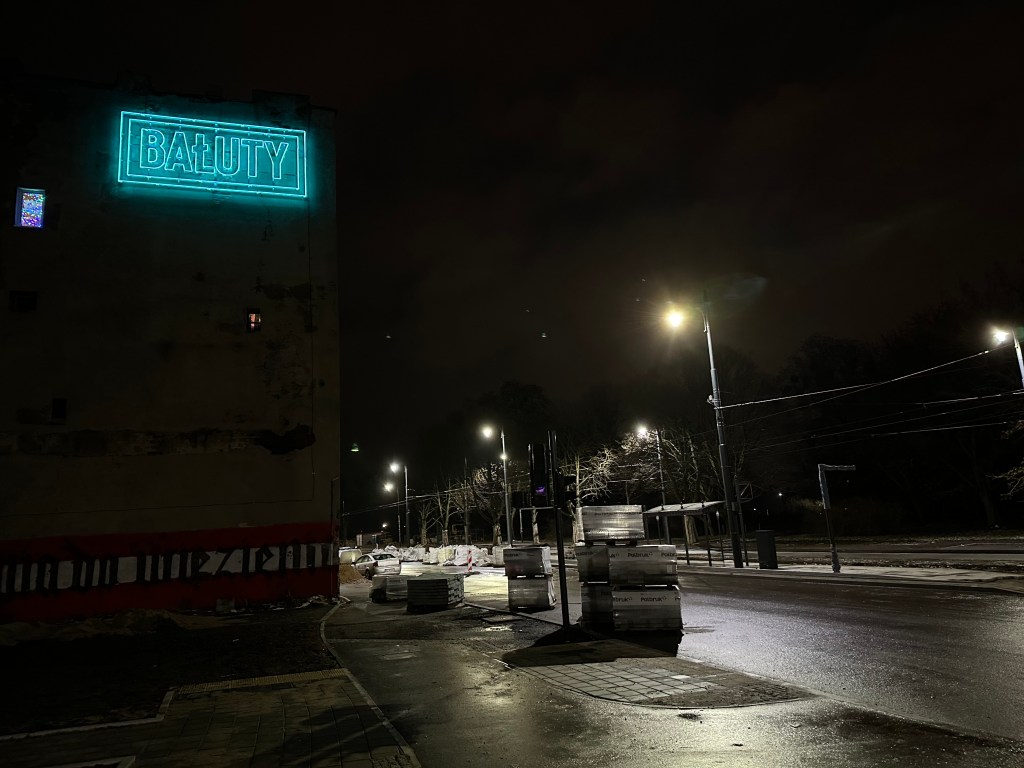
Beauty / Bałuty by Gouda
In addition to the paintings, there is a neon sign in Baluty designed by local artist Gouda. You can find it on the corner of Wojska Polskiego and Franciszkańska. The message is super simple even without knowledge of the Polish language, you will manage to understand. 🙂

What is the best way to get to know Bałuty?
Personally, I like to explore Bałuty in a small group, 3/4 of a person at most. This way I feel that I am not violating the existing situation. I am just a harmless observer. I usually like to explore this way, but in the case of Baluty, I think it is essential.
Do I have some advice for you? Well, maybe a bit. Firstly, English may be a problem in local stores. Secondly, if you plan to shop in the local market, it’s a good idea to have some cash. And well, not every gate is always worth entering. Although this one is changing more and more, for the better. 😉
Map of murals on Baluty
To make it easier for you I’m posting a map with all the street art I’ve found in Bałuty. I try to keep it updated. 🙂

If you ever go to Bałuty, let me know what your impressions are. I’m curious if you agree with what I wrote here. Or the complete opposite? 🙂
Like it here? Say YES by supporting me. ⸜(。˃ ᵕ ˂ )⸝♡
See you in Lodz!
K.
Sources:
Lodz Travel, Urban Forms Fundation, Baedeker Łódzki, Miej Miejsce, Urząd Miasta Łodzi, Centrum Dialogu im. Marka Edelmana, Festiwal Łódź Wielu Kultur, Ludzki Kot
 Part of Streets
1 Comment